AI visibility for B2B is about being chosen for what you can do. When a buyer asks ChatGPT, Copilot or Google AI Overview who supplies what she needs, your expertise has to be available and well documented there too, not only among people who already know you. B2B purchases involve several roles, long processes and questions so narrow they barely have search volume: only a handful of the keywords in K—lab's own niche have measurable volume in Google Ads. That is why we measure questions, not keywords.
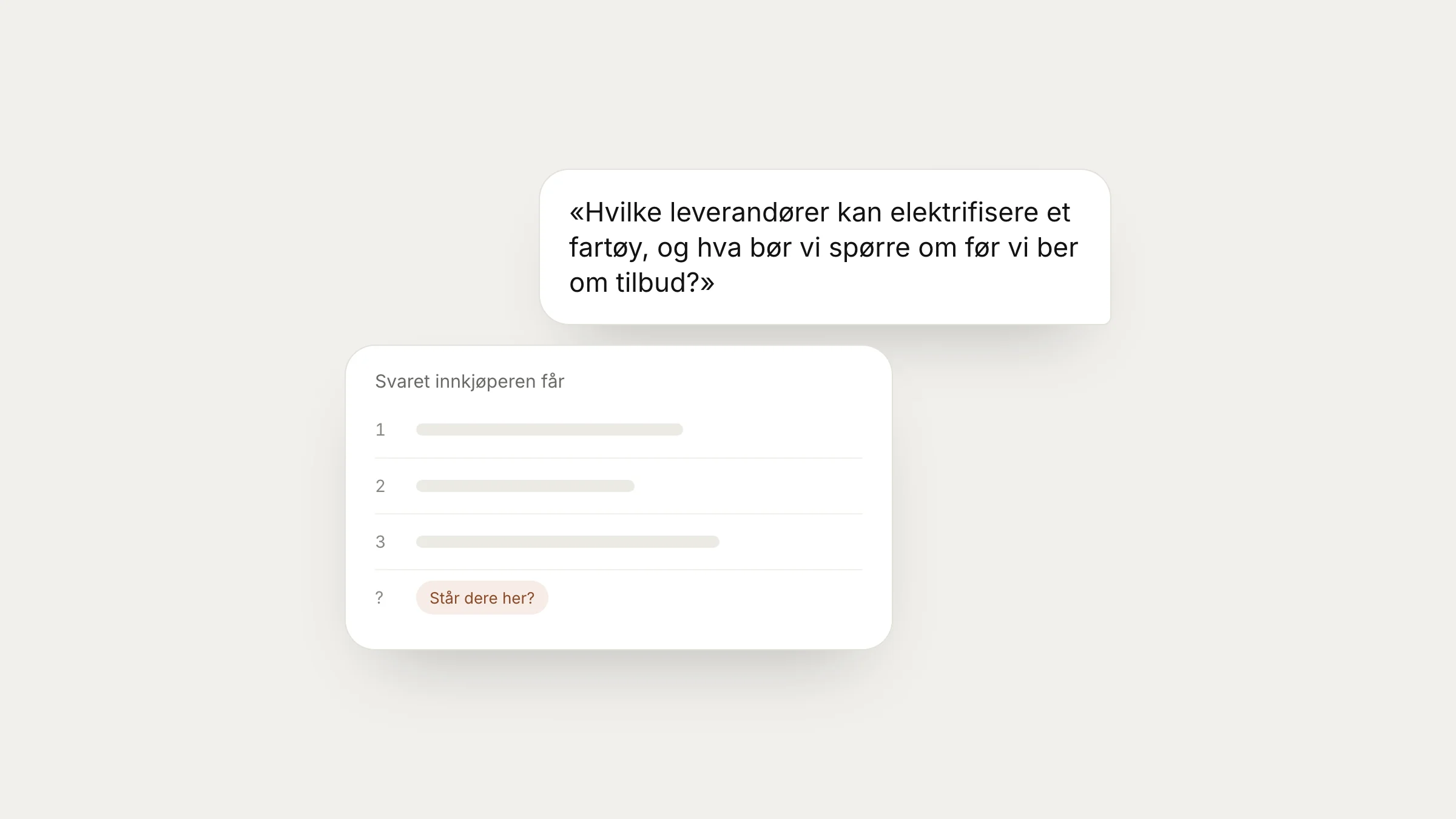
Picture a buyer at a shipyard. She needs to find three suppliers for a retrofit that can't be bought off the shelf, and she has a week. Before she calls anyone, she types the whole problem into a chat, with industry, country and requirements. The answer is a short list of names. If you're not on it, you don't get the call, and you never find out it happened.
More and more buyers work this way. Below is what the surveys show, why keyword tools don't see it, and how we have built K—lab for this situation. We also say where we stand ourselves, and it isn't a flattering position.
Yes, and the share appears to be growing. Three surveys, all of buyers globally and none of Norwegian buyers specifically:
G2 surveys software buyers, and Forrester asks business buyers globally. Neither has asked Norwegian buyers in maritime, energy or aquaculture. The numbers show the direction, not how far Norwegian buyers have come. We don't have a figure for that.
Because there isn't one buyer. Forrester found that a typical purchase involves on average 13 internal participants and nine external influencers. G2 sees smaller groups, three to four in many software purchases. The numbers aren't directly comparable, but both say a purchase passes through many hands.
So a purchase is many questions, not one. A finance manager asks about price and risk, a specialist about what actually works and an executive about who else in the industry uses it. All of them can ask AI, and they get different answers because the questions are different. The purchase also takes time, and the questions come in phases: first “what is the problem,” then “who is out there,” and finally “what sets them apart.” Being visible in only one phase isn't enough.
Because they count searches, and the narrow B2B questions are searched so rarely that they don't show up. We checked the keywords in K—lab's own niche against Google Ads search volume for Norway. Only a handful had measurable volume.
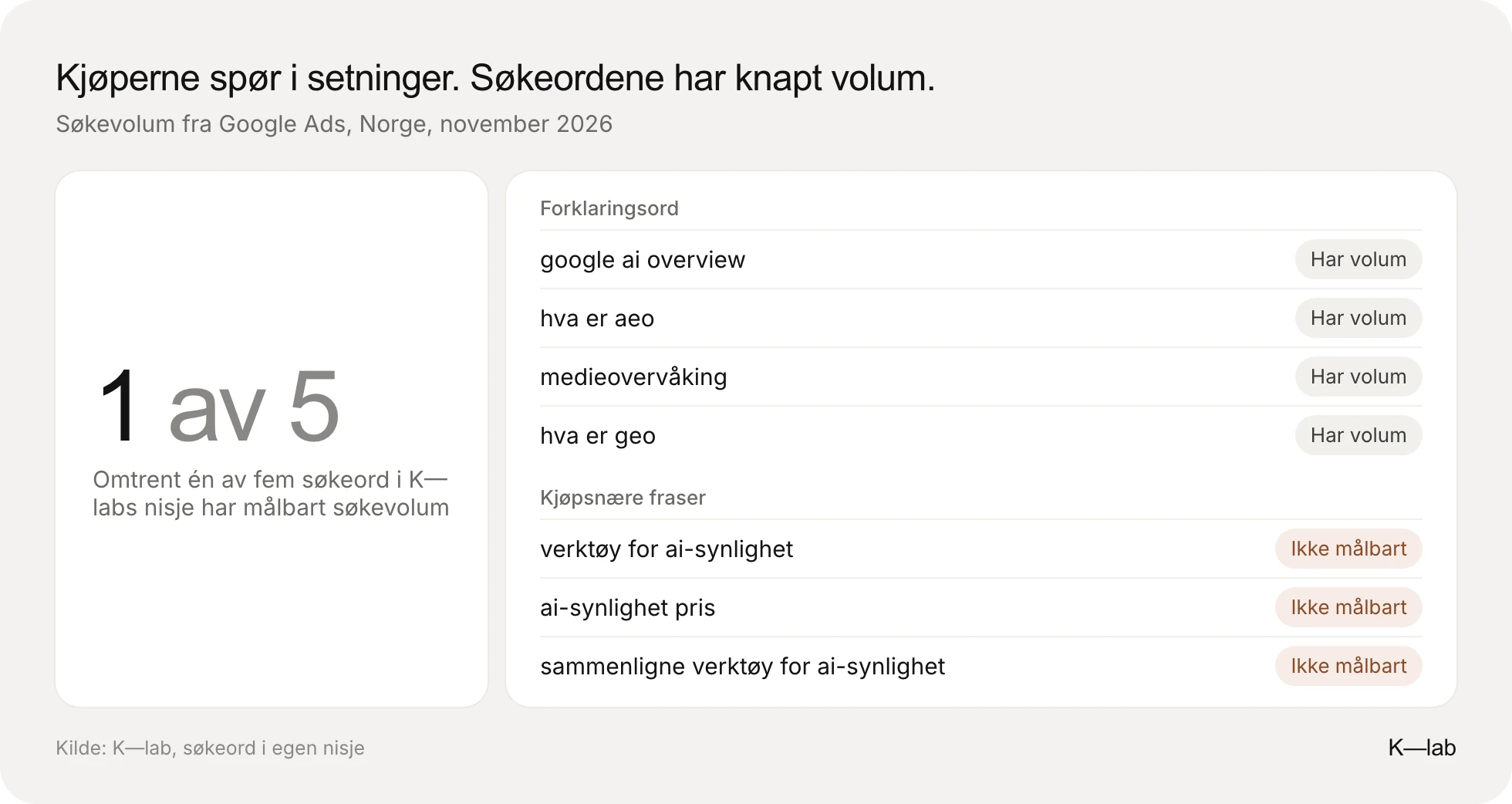
The terms with volume were explanatory ones, such as “google ai overview” and the Norwegian for “what is aeo,” “media monitoring” and “what is geo,” each with a few dozen searches a month. The purchase-intent phrases, such as the Norwegian for “ai visibility tools” and “ai visibility pricing,” had no measurable volume.
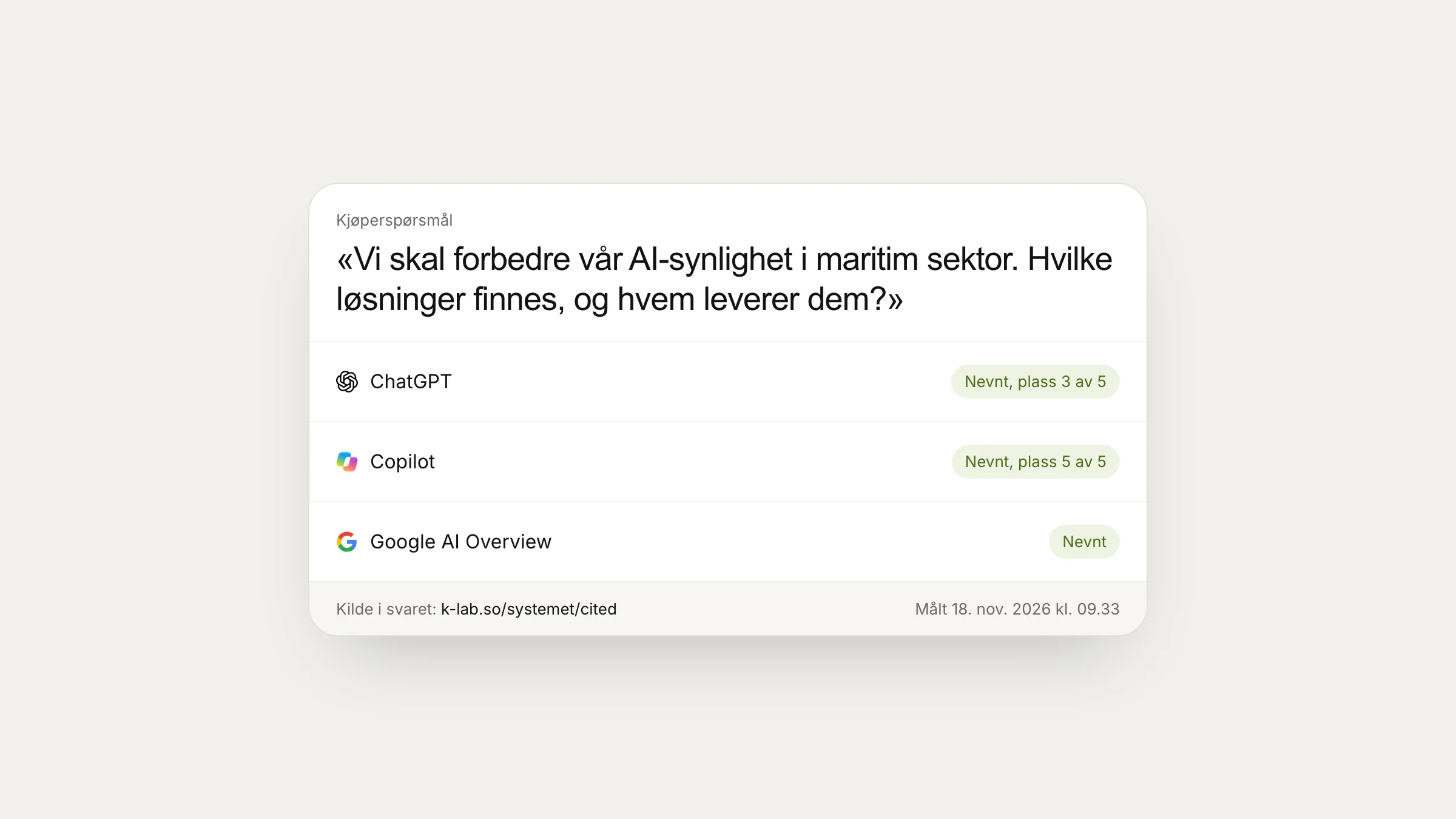
“Not measurable” doesn't mean zero. Google Ads doesn't show volume below a certain threshold, and we don't know how many people actually search. But a keyword tool can't tell you what buyers are asking. And buyers no longer ask in keywords. They write full sentences, such as “We want to improve our AI visibility in the maritime sector. What solutions are out there, and who provides them?” (asked in Norwegian). We have measured words in one niche. Whether another B2B niche looks the same, we haven't tested.
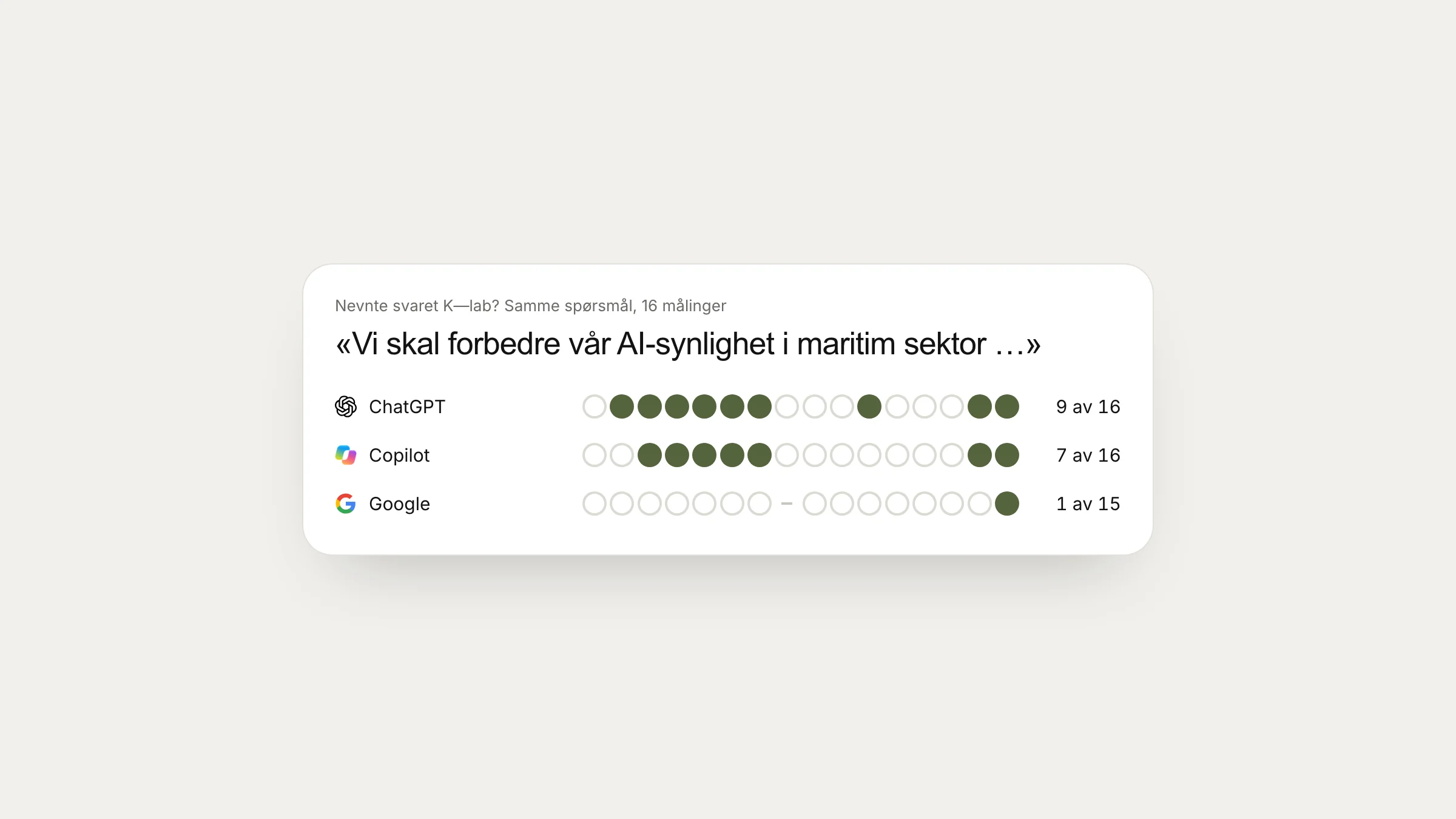
We asked the question above to all three services on November 18, 2026 at 09:33 (Norwegian time). All three mentioned the same five vendors, in a different order. All three cited the same five websites, and Sorank's maritime page came first. That page is built for exactly this buyer.
For us, the finding is sobering: we have no maritime page with the same precision. The fix is a dedicated page with references from the industry. In Cited it becomes a task in Work, and at the next measurement we see whether the way we are mentioned has changed. There is more on the example in our article on the data behind Cited. It's one question at one point in time, and one of many neutral ones, so don't read it as an average.
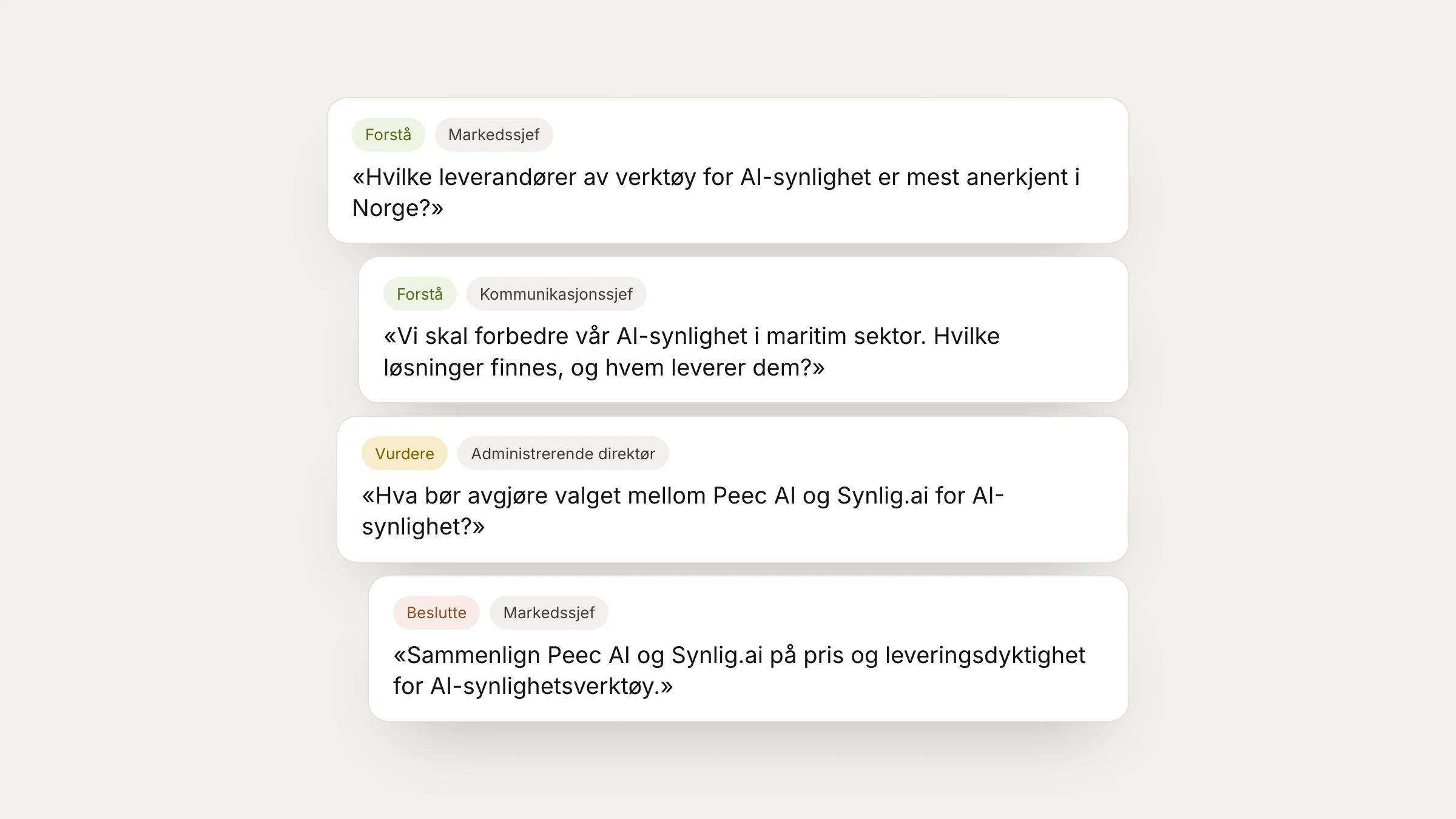
The measurement follows the buying process, not the keyword list. K—lab's own measurement consists of a fixed set of questions, asked to ChatGPT, Copilot and Google AI Overview every other day from October 19 to November 18, 2026. The questions are spread along three axes.
Roles: about a third are written for a head of marketing, a quarter for a head of communications, just under a fifth for a CEO and about 15% for a content manager. The rest start from a competitor. The AI services don't know who is asking, so we test what a person in that role would write.
Buying phases: more than half of the questions are in the understand phase, about a quarter in the evaluate phase and under a fifth in the decide phase.
Industry: many questions put the industry in the sentence, the way a buyer there would write it, for example maritime and aquaculture: “Which AI visibility tools are available for aquaculture companies in Norway, and who provides them?” The vast majority are neutral, meaning K—lab isn't in the question. How we choose them is explained in How we choose the questions.
A few numbers from K—lab's own reports, with links so you can check them:
Poorly. We build a tool for B2B and measure ourselves on the questions a B2B buyer asks, and the result isn't something we want to hide.
In the “AI visibility tools” cluster, K—lab was mentioned in only a handful of the answers in the latest measurement. “Which providers of AI visibility tools are most recognized in Norway?” produced no mentions in the last ten days. “We need a solution to improve our AI visibility. Which companies in Norway are worth checking out?” produced none either. The only question in the cluster where we show up is the maritime question above.
The most cited websites in the same cluster over the last ten days were synlig.ai, citationlab.no, nettpilot.no, sorank.com, amicited.com, vctra.no and tryprofound.com. We are not among them.
With keywords, we would not have seen this. Measuring questions shows where we lose, and that is where we are working.
It depends on who has the time. K—lab is made by Kommunikasjonshuset AS in Avaldsnes, Norway, known as K—huset, which works day to day on communications for complex industries: energy, maritime, aquaculture and technology. Our questions come from there, not from a general-purpose tool that was later adapted to B2B.
K—lab suits companies where a marketing manager has the time and mandate to run the work herself. We help her get started with one recurring task, for example following in Cited how the company is described when buyers research a purchase. You can also buy help from the specialists for a specific task. You arrange that with us. It isn't a button in Work.
K—huset Team suits companies that want someone to take ongoing responsibility together with them: a dedicated advisor who brings in a writer, designer or film crew as needed.
Write down ten questions a buyer in your industry would ask, one for each role in the purchase and each phase, without naming your company. Ask them to ChatGPT and Copilot several times, and count how many answers mention you. Write down the numerator and the denominator. That is how we do it too, and our guide to measuring AI visibility shows how to calculate it.
If you want it done for you, you can get a free AI visibility check. If you want to follow the trend, you'll find Cited and pricing here, and the comparison shows how we stack up against others.
It is how often ChatGPT, Copilot and Google AI Overview mention, cite or recommend a business when a buyer asks about suppliers in its industry. It is measured by asking buyer questions several times and counting the answers.
Yes. In G2's survey of more than a thousand decision-makers (March 2026), 51% said they start software research with an AI chatbot more often than with Google, and Forrester writes that 94% of buyers in a global survey use AI in the buying process (January 21, 2026). Neither survey is Norwegian.
Because narrow B2B questions have little search volume. Of the keywords in K—lab's niche, only a handful had measurable volume in Google Ads for Norway, and the purchase-intent phrases had none.
K—lab suits a marketing manager who wants to run the AI visibility work herself. K—huset Team suits companies that want a dedicated advisor to take ongoing responsibility together with them.
The typical company is mentioned in about 8% of AI answers about its industry, one in twelve (K—lab, August 2026). The most visible company was mentioned in about 38% of answers, and a few were almost never mentioned.
We asked ChatGPT and Copilot buyer questions every other day for a month. See how much the answers change, and why a single answer is only a snapshot.
K—lab asks buyer questions written from buying situations in industry and the maritime sector. Here is how they are chosen, and how to build your own list.
Over 100,000 AI answers and over 600,000 source citations. What sets the data in Cited apart, how we count and what the measurement does not capture.
Spend less time gathering and explaining results. Spend more time on the actions that actually deserve attention.