K—lab asks ChatGPT, Copilot and Google AI Overview a fixed set of buyer questions. The vast majority are neutral and don't mention K—lab, while a few mention us by name. The questions are spread across buying phase (more than half in the understand phase), roles and topics, and many of them are written from a specific industry, such as maritime, aquaculture or energy. The neutral ones count most, because only they show whether a buyer who doesn't know us gets to hear our name.
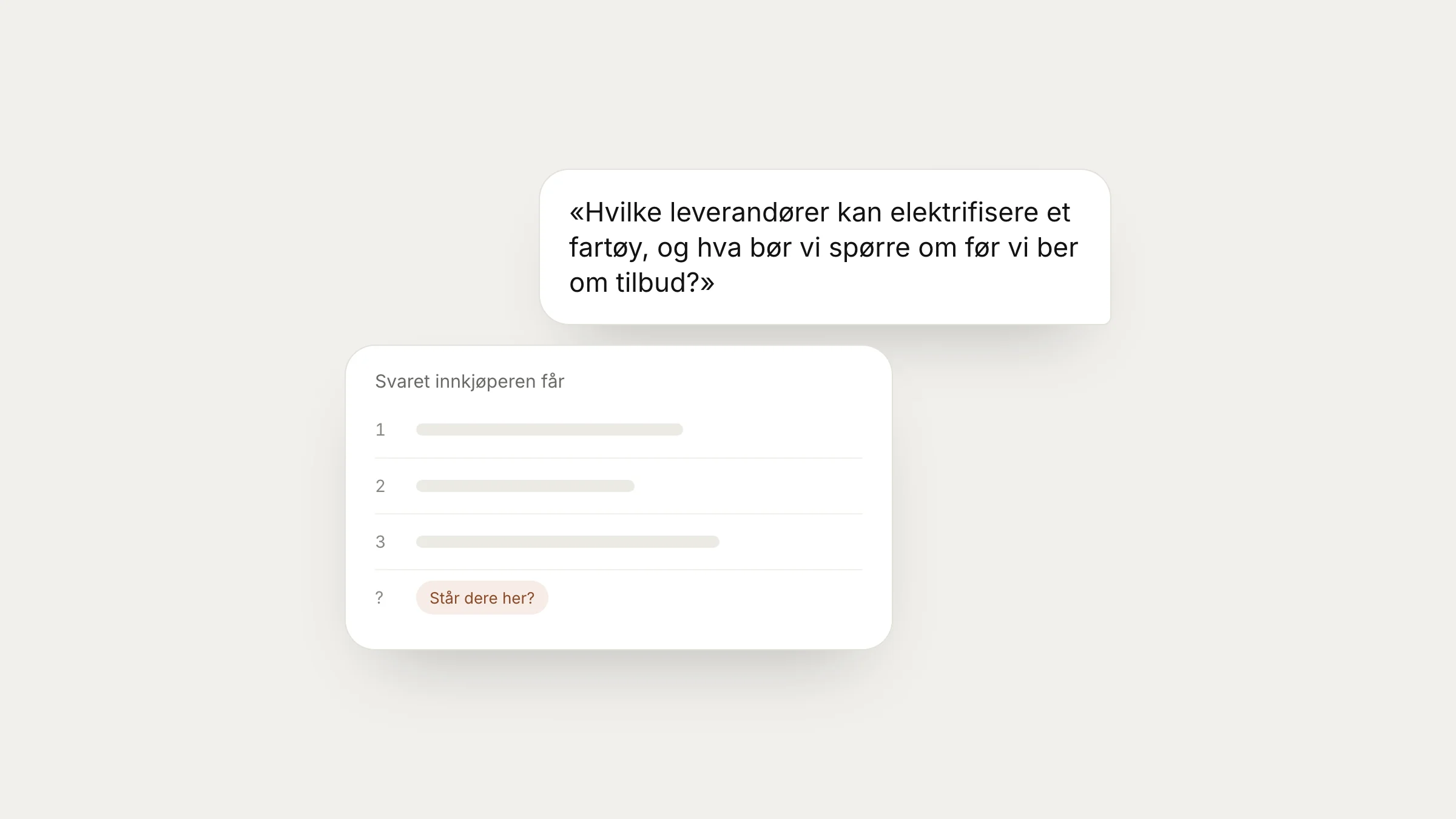
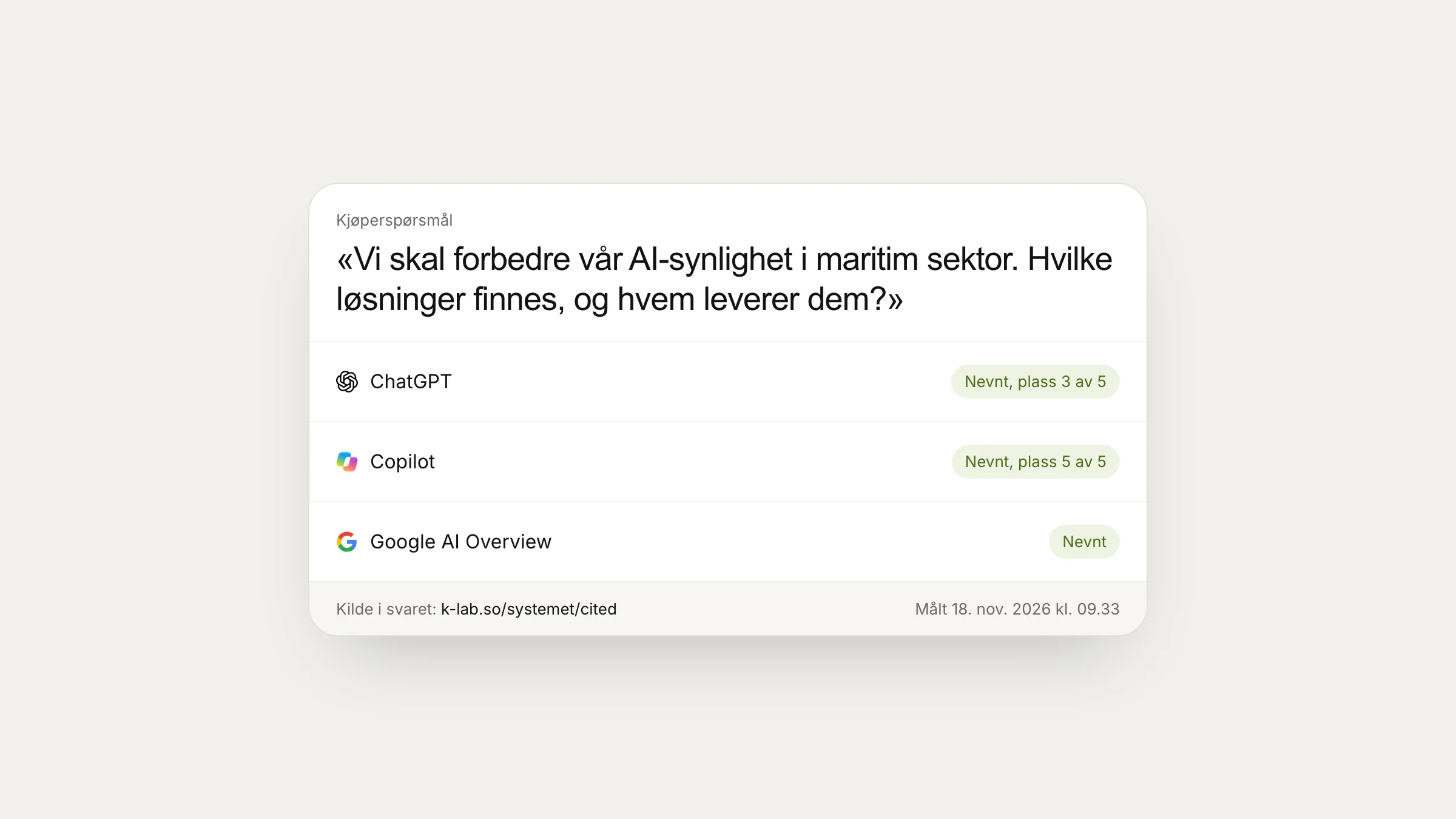
Thursday afternoon. The marketing manager at a maritime equipment company has been asked by management to look into AI visibility. She opens ChatGPT and types: “We want to improve our AI visibility in the maritime sector. What solutions are out there, and who provides them?” (asked in Norwegian).
It's one of the questions we ask in our own measurement. When we asked it on November 18, 2026 at 09:33 (Norwegian time), all three services mentioned the same five vendors, in a different order, and K—lab was in all three answers. But the question isn't on the list because we come out well. It's there because that's how a buyer writes. It's the only question in its cluster where K—lab shows up.
The rest of this article is about how the list is made and how you can make a similar one. What we did with the answer is covered in our article on the data behind Cited.
A tracked question, often called a prompt, is a sentence we ask all three services in exactly the same way in every measurement. Each one has three labels: buying phase, role and topic.
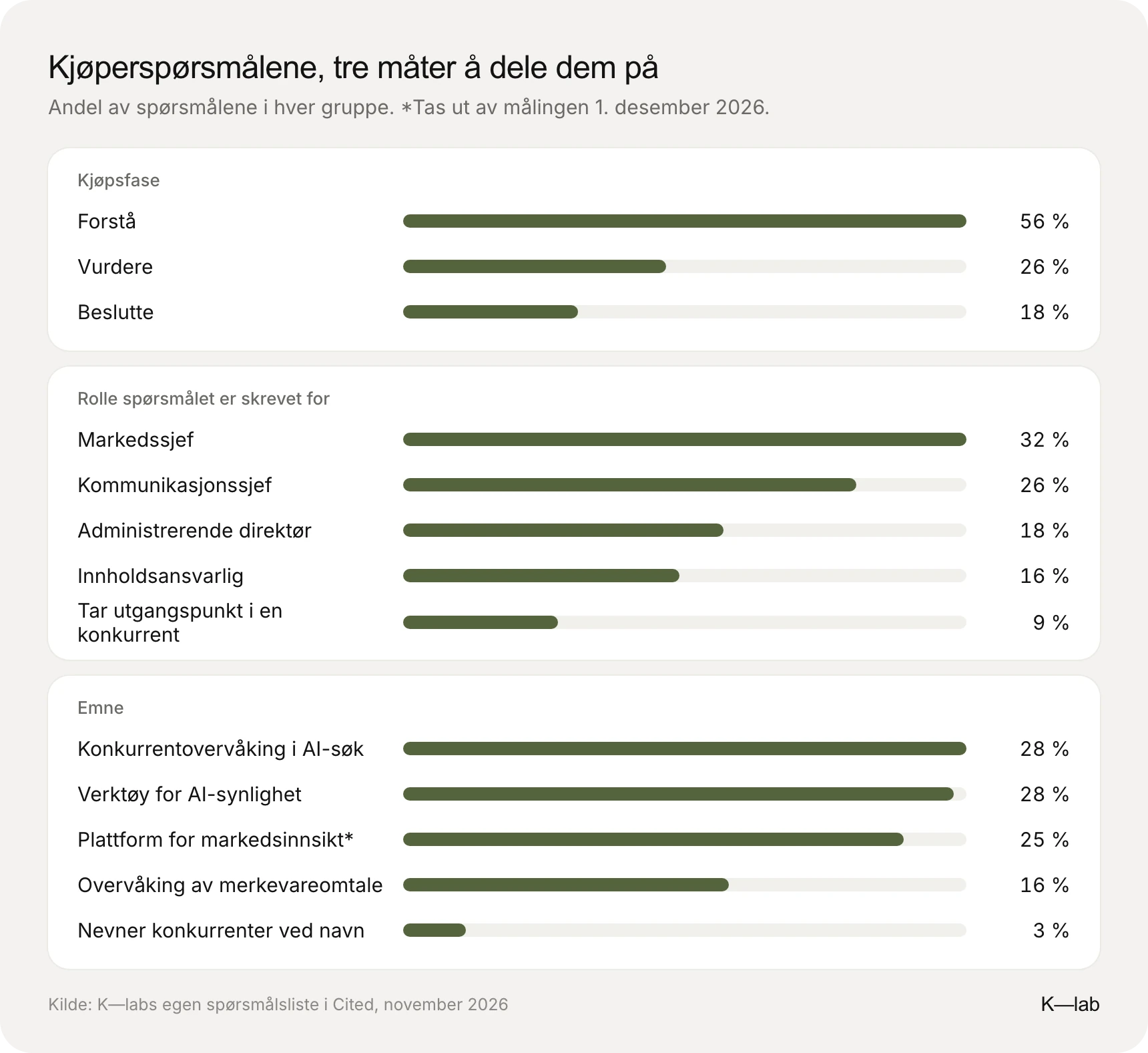
The buying phases are skewed on purpose. More than half of the questions belong to “understand,” because that's where most purchases begin: someone has a problem and doesn't yet know what the solution is called. About a quarter are “evaluate,” meaning comparing vendors, and under a fifth are “decide.”
There are four roles plus one. About a third are written for a head of marketing, a quarter for a head of communications, just under a fifth for a CEO and about 15% for a content manager. The rest start from a competitor. Purchases are rarely made by one person.
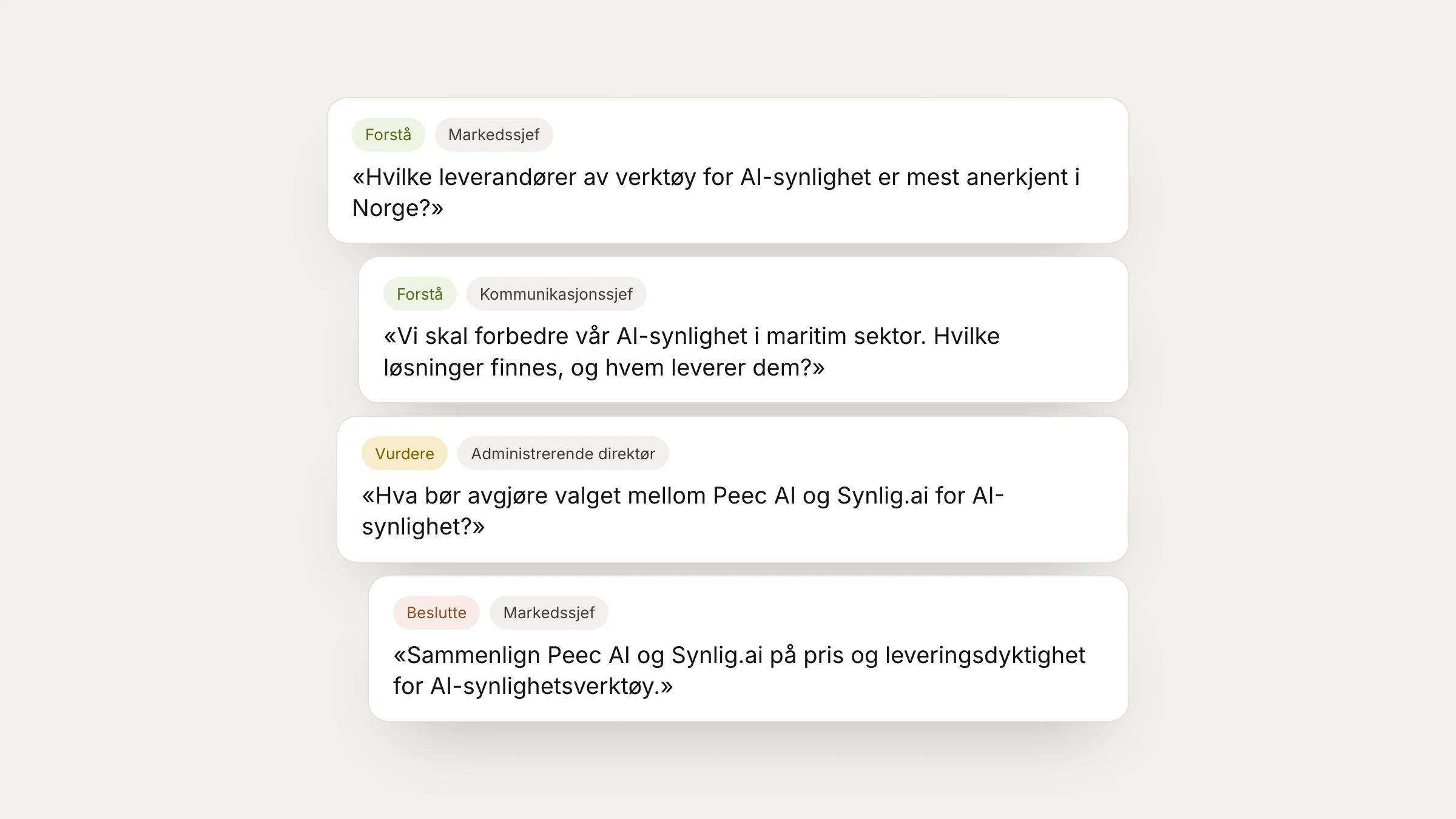
Here's what some of them look like, translated directly from the Norwegian:
None of them mention K—lab. They're written the way a buyer writes, not the way we talk about ourselves.
From the buying situation, not from a keyword tool and not from a meeting room. A buyer at a shipyard doesn't type “AI visibility pricing.” She writes out her problem: what she needs to refit, which requirements apply and what she needs from a supplier. It's the same in industry. Someone who needs to replace a pump supplier asks who can deliver, to which countries and with which certifications.
Two examples of the form. They're made up to show the type of question. They're not taken from our measurement, and we make no claims about what AI answers to them:
Both have a situation and an industry, both ask for names, and neither mentions a specific supplier. The question from the opening is built the same way: “We want to improve …” sets the situation, “in the maritime sector” sets the industry, and “who provides them” asks for names.
The best source is the people who talk to your customers. Ask your salespeople what customers asked about the first time they called, and read old requests for quotation. We haven't measured whether buyers ask AI the same things, but it's a better starting point than a keyword tool.
A branded question has our name in it, and a neutral one doesn't. Only a few of the questions mention K—lab by name. The vast majority are neutral.
When the question says “K—lab,” the answer is about K—lab, almost regardless of what is true about the market. It tells us what AI thinks of us when someone has already heard of us, and we keep track of that: the tone, whether AI confuses us with others, and what it claims we don't have. But it says nothing about whether a new buyer finds us.
The neutral questions do. That's why only they go into the denominator of our mention share, and why the two types never appear in the same number.
Here is what the neutral questions say about us. In the “AI visibility tools” cluster, K—lab was mentioned in only a handful of the answers in the latest measurement. Maritime is where we show up: the question from the opening is the only one in the cluster that includes K—lab. The question “We need a solution to improve our AI visibility. Which companies in Norway are worth checking out?” produced no answers with K—lab in the last ten days.
If we had measured only branded questions, the picture would have looked good. That's why we don't.
Because K—lab doesn't sell it. From December 1, 2026, the topic is removed from the measurement, and it makes up a quarter of the list.
A question where K—lab can't be the right answer doesn't measure visibility for what we deliver. If it stays, it pulls the mention share down without saying anything about the product. Or worse: if we get a mention there, it can look like a win we don't deserve.
This comes at a cost. The numbers before and after December 1 are based on two different lists, and we don't compare them without flagging the break. The same goes for you: every time the list changes, you have a break in the time series.
Because AI services with web search often don't search for the question the way the buyer wrote it. They split it into several sub-searches, which is called query fan-out. From December 1, we're adding five questions written from how the AI models themselves break questions down.
We can't see the searches the services run. What we did was ask an AI to break some of our questions into sub-questions and see what it asked for. The pattern was clear: price, which AI search platforms, languages and markets are covered, customer types and industries, and data sources and how often they're updated.
This is modeled, not observed, and it's a starting point, not proof. But it points to something we can act on: a buyer evaluating vendors wants answers on price, underlying data and reporting. Our article on the data behind Cited is written to answer exactly that.
Because the keywords we care about have almost no search volume. Of the keywords in our own niche, only a handful have measurable search volume in Google Ads in Norway. “google ai overview” and the Norwegian for “what is aeo,” “media monitoring” and “what is geo” get a few dozen searches a month. The purchase-intent phrases, such as the Norwegian for “ai visibility tools” and “ai visibility pricing,” have no measurable volume.
Still, “not measurable” isn't 0. It means the numbers are missing, and long, niche phrasings are poorly captured by statistics like these. We don't know how many people ask AI about this. We do know that AI questions are often full sentences, and that keyword tools don't show them. Full sentences are what we ask.
How many questions to use and how to spread them across buying phases is covered in the guide to measuring AI visibility. Here is what we have learned from building a long list.
Finally, test each question: could a customer have written this? If not, rewrite it.
The list is our selection, not a random sample of everything buyers ask AI. We can't see what people actually type into ChatGPT, so the questions are our best guesses, supported by how the models themselves break down questions.
They're in Norwegian and written for our own niche. The answers we collect aren't personalized (no logged-in history, memory or location), so an individual user may get something different. And the list is built around what we want to be found for, which makes it easy to measure what flatters us. That's why we say it plainly: in the cluster where customers look for exactly what we sell, we were mentioned in only a handful of the answers.
Want to see which questions AI gets about your industry, and whether you're in the answers? Start with a free AI visibility check, or see how Cited tracks the same questions over time and turns the findings into tasks in Work.
A fixed set of tracked buyer questions, asked to ChatGPT, Copilot and Google AI Overview. The vast majority are neutral, and a few mention K—lab by name. From December 1, 2026, a quarter of the questions, those about “Market insight platform,” are removed, and five new ones are added.
A branded question mentions your brand, and the answer is then almost always about you. A neutral question doesn't, and only a neutral question shows whether a new buyer gets to hear your name. We count them separately.
Full sentences about their own situation, for example “We want to improve our AI visibility in the maritime sector. What solutions are out there, and who provides them?” Many put the industry and the country in the sentence, and few of them exist as keywords.
Because K—lab doesn't sell it. Questions where we can't be the right answer don't measure visibility for what we deliver. We flag the break in the time series from December 1, 2026.
Start with the buying situations and the roles in the buying group, spread the questions across the buying phases, write from the customer's situation, keep questions with brand names out of the denominator, and change the list rarely.
B2B companies with deep expertise should be chosen for what they can do, even when the buyer asks AI first. Here are the surveys, the numbers and where K—lab itself stands.
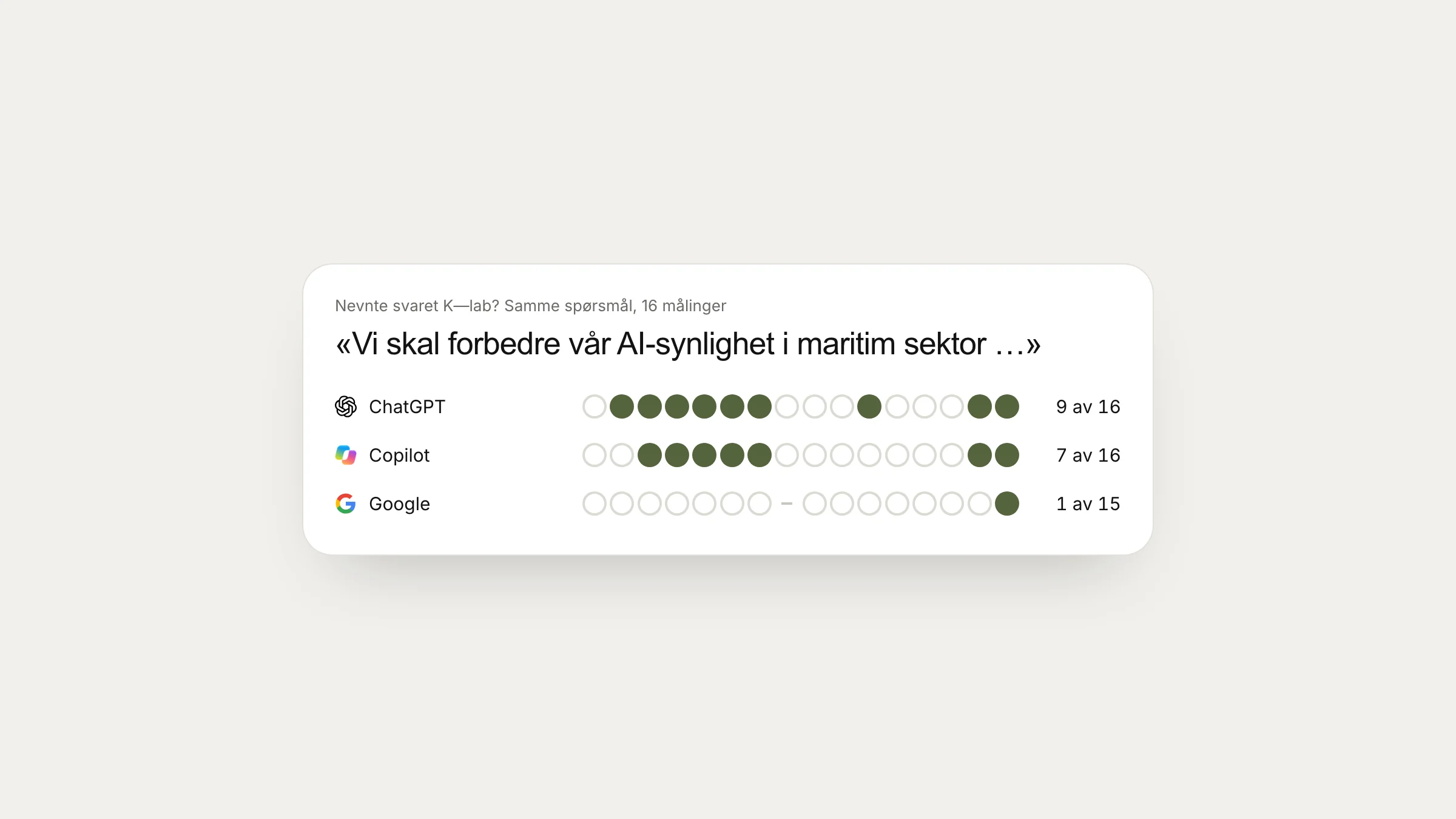
We asked ChatGPT and Copilot buyer questions every other day for a month. See how much the answers change, and why a single answer is only a snapshot.
Over 100,000 AI answers and over 600,000 source citations. What sets the data in Cited apart, how we count and what the measurement does not capture.
Spend less time gathering and explaining results. Spend more time on the actions that actually deserve attention.