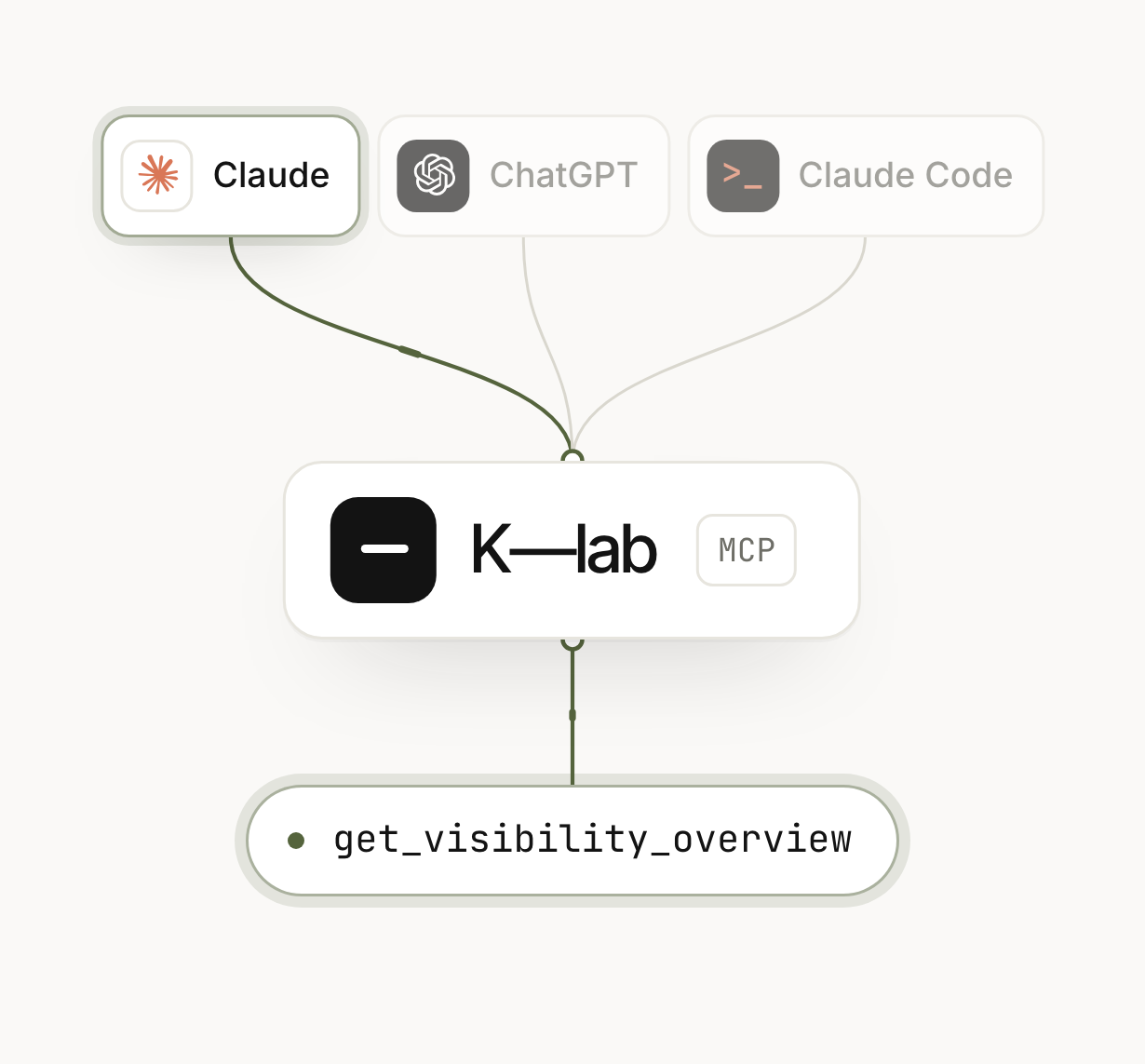
The data behind Cited is over 100,000 AI answers from ChatGPT, Copilot and Google AI Overview, collected regularly for a fixed set of buyer questions. For each answer we see whether the brand is mentioned, who is mentioned instead and which web pages the answer points to. Every number has a numerator and a denominator, and anything not measured is left blank, not shown as 0%.
Picture a board meeting. The slide says “3%,” and above the number it says “AI visibility.” The chair looks up: three percent of what? Of which questions, to which service, when, and how many times?
If no one in the room can answer, the number is decoration. That is why we write down the basis for our numbers, including where it does not flatter us. Cited is the measurement in K—lab, and we use it on ourselves first. The examples here are from our own workspace. How to calculate the numbers yourselves is covered in How to measure AI visibility, and what the term means in What is AI visibility? This article shows what sits underneath our own numbers.
A big number alone does not make a measurement good. We have tested what happens when a measurement uses the wrong language, measures too rarely or does not check the answers behind the number, and built Cited on what we found.
The language decides which web pages the AI reads. In our maritime report, about 56% of the sources were Norwegian when the buyer asked in Norwegian, and about 6% when the buyer asked in English. If you measure only in English, you see a different market from the one Norwegian buyers encounter. That is why most of the questions in Cited are written in Norwegian, the way a buyer would write them.
The same question does not always return the same names. In our own measurement, when a brand was mentioned, the list of brands changed in over 40% of cases from one measurement to the next. A screenshot from ChatGPT is only a snapshot. Cited asks the same questions every other day and reads the trend over weeks.
When we read the answers behind our own number, we found mentions of another company with the same name. Without that check, the number would have looked too good. In Cited you can open every number and see the question, the answer, the sources and when it was measured.
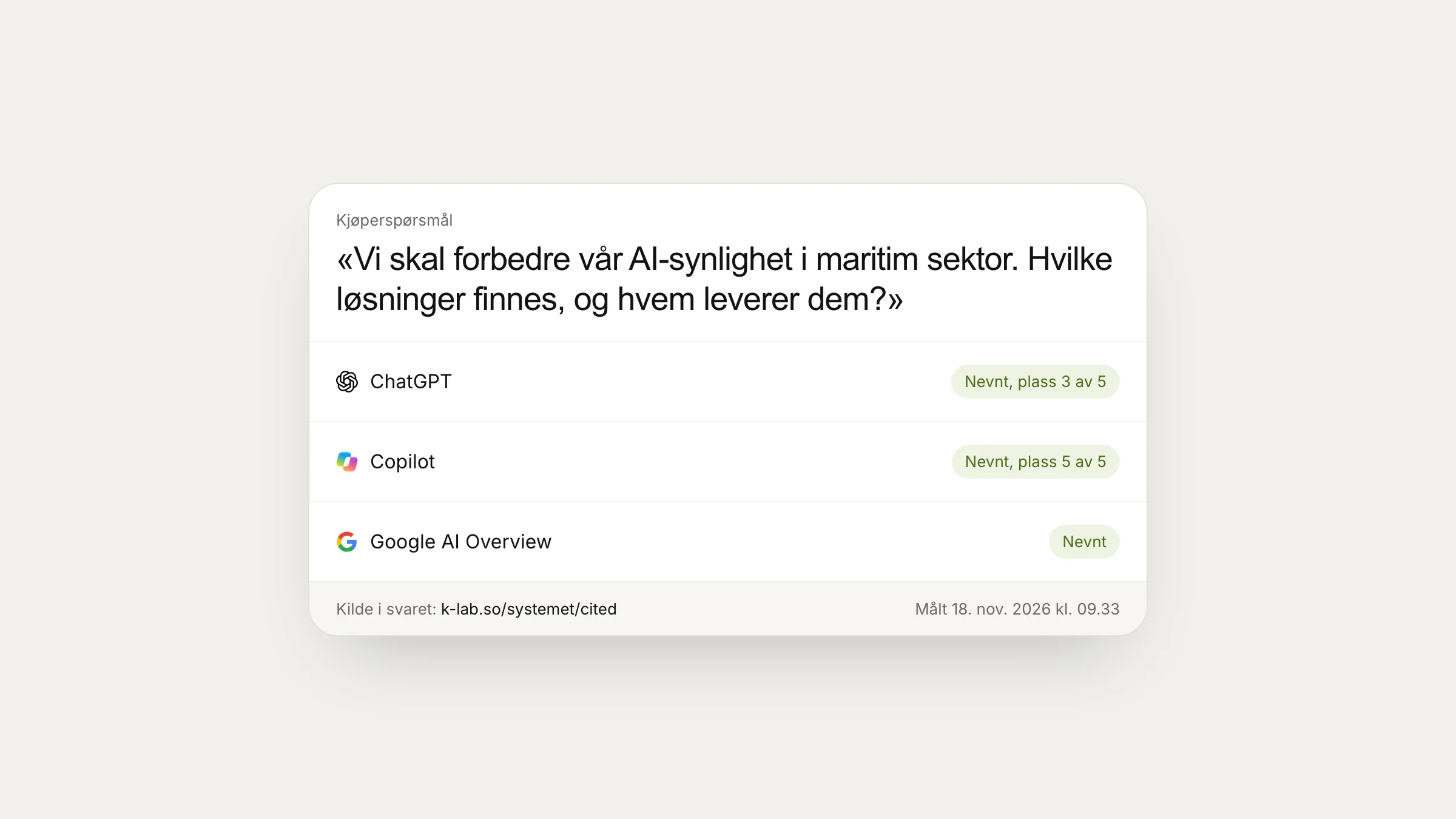
Take the question “We need to improve our AI visibility in the maritime sector. What solutions are there, and who provides them?”, asked in Norwegian on November 18, 2026 at 09:33 (Norwegian time). ChatGPT described Cited as a tool that “measures how ChatGPT, Microsoft Copilot and Google AI Overview describe, cite or recommend the company” (translated from the Norwegian answer), and linked to k-lab.so/systemet/cited. The finding was that all three services pointed first to an industry page about shipping from another vendor, while we only have a general page. The action is a dedicated maritime page with references, added as a task in Work. The next measurement will show whether it gets used as a source.
If you are considering another tool, ask the vendor the same three questions: Which language do you measure in? How often is each question measured? Can I read the answer behind the number?
Three services: ChatGPT, Copilot and Google AI Overview. Together, there are over 100,000 AI answers in Cited.
Google AI Overview has fewer answers than the other two, and that is not an error. Google does not show an AI Overview on every search. On the same questions, ChatGPT and Copilot gave about the same number of answers, while Google showed an AI Overview about three times out of four.
Every other day. From October 19 to November 18, the same questions were put to the same services every other day.
With the questions held fixed, we can tell change from noise, and we read the trend over weeks. From December 1 we are adding five questions, and we explain that in the article about the questions.
We store the answer itself, and alongside it we record six things:
In Cited you can open the answer behind every number and read the wording, the competitors and the sources yourself.
The numerator is the number of answers that mention the brand. The denominator is the number of answers to questions that do not name the brand, from that service, in that period.
We keep two types of questions apart. Some of the tracked questions mention K—lab by name, and the answers to them are about us almost regardless of what is true about the market. The vast majority are neutral, and only those tell us whether a buyer who does not know us gets to hear our name. Why the neutral ones count most is explained in the article about the questions.
Small denominators give uncertain numbers. If the denominator is small, the true share can be quite far from what we see, so no one should read anything into a small jump.
0% means we measured and the brand was not mentioned. “Not measured” means we have nothing to calculate from.
On the neutral questions, Google showed an AI Overview about four times out of five, while ChatGPT answered almost every time. The times Google showed nothing are not “not mentioned.” Google showed nothing. Had we counted them as no, Google's mention rate would have looked lower without anything having changed. The same applies to the few answers missing from ChatGPT and Copilot.
By reading the answers that mention us. The name “K-lab” is also used by a gas metering test center at Kårstø, and the AI services sometimes mix them up. On November 4, 2026, Google AI Overview answered “What questions should we ask K—lab before we sign an agreement?” by saying you should ask about test conditions, accreditation and handling of raw data, and put “Kårstø Metering and Technology Laboratory” in parentheses after the name. That is not a mention of us.
From November 4 to 18, 2026, the name K-lab appeared in the text of about 15% of the answers. Only a handful of them mentioned the test center. Half of those were about the wrong company and were not counted as mentions of us. In the rest, the service itself wrote that the name can be confused, and the question mentioned K—lab. It is a small number, but without the check the number would have looked too good. If others also use your name, read a sample of the answers before you trust the percentage.
Less stable than a percentage with one decimal makes them look. The table shows the variation between two consecutive measurements, for neutral questions and the brands we track (K—lab and its competitors). Google AI Overview is not included.
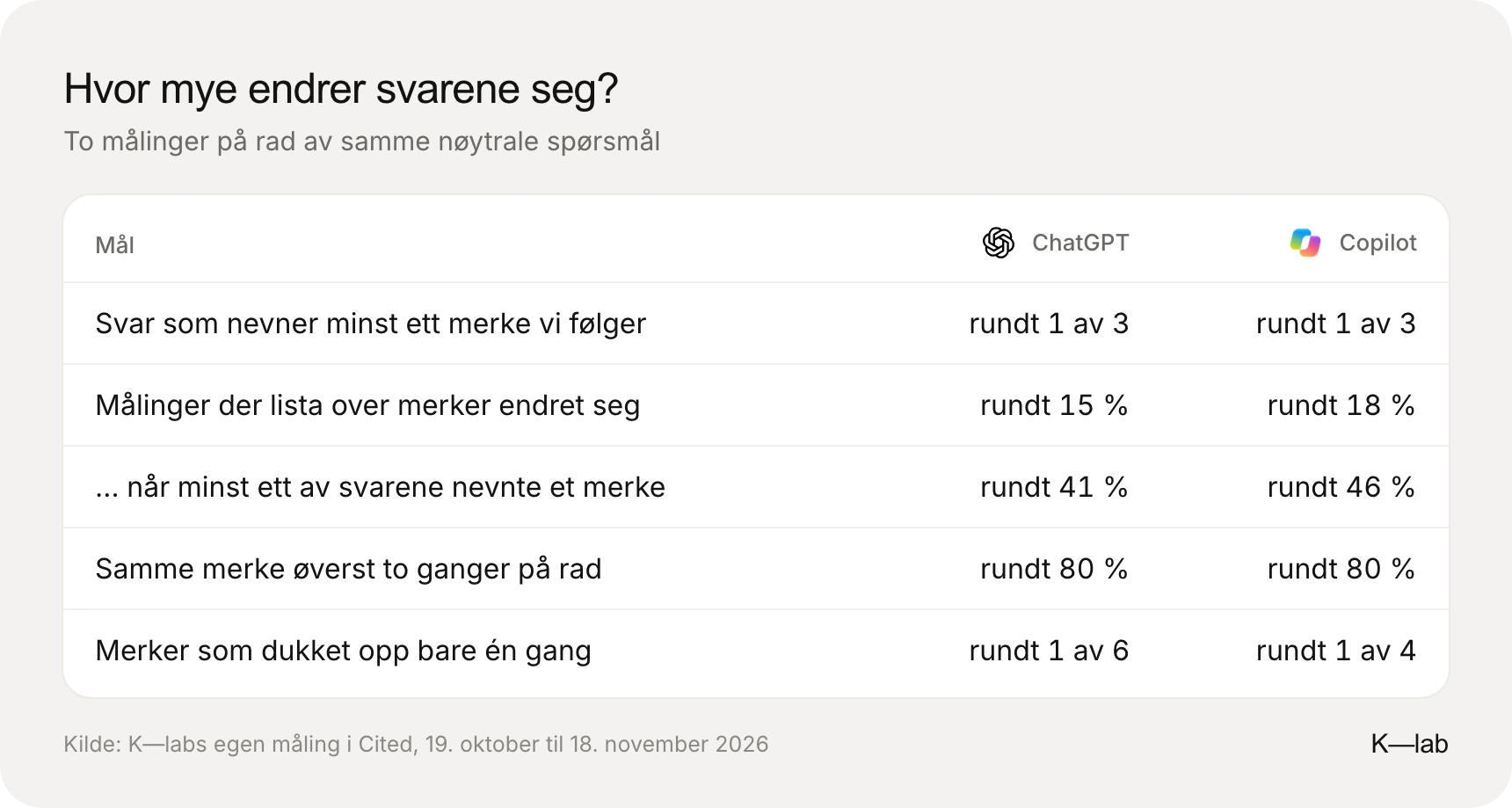
How large the variation is depends on what we count. Most answers mention none of the brands we track and never “change,” so if we take all pairs, the share is low. If we take only pairs where at least one answer mentioned a brand, it is more than double. Our guide gives a lower number, because it uses a different sample: other dates (November 4 to 18, 2026), more platforms, and also pairs without brands. All the numbers are correct, which is why we always state what we count. The full analysis is in the article on why answers vary.
A lot. We would rather say so ourselves.
Take a free AI visibility check and see how often ChatGPT, Copilot and Google mention you. Or put the question from the example above, in a version for your industry, to each service by hand. Do it three times in new chats, and log the numerator, denominator and date in a spreadsheet.
To follow the trend, open the answers behind the numbers in Cited. See the pricing page and the comparison with other tools. And if you suspect a number does not hold up, ask for the numerator, the denominator and the date. If you do not get all three, that is reason enough.
Over 100,000 AI answers from ChatGPT, Copilot and Google AI Overview, collected regularly for a fixed set of tracked buyer questions.
The questions are mostly in Norwegian, the same questions are measured every other day, and every number can be opened to show the question, answer, sources and time. The data covers over 100,000 AI answers with over 600,000 source citations.
The measurements run every other day, and we read the trend over weeks because individual measurements vary.
Not necessarily. The answers we collect are not personalized (no logged-in history, memory or location), which makes them comparable over time. An individual user may get something different.
That we have no basis for a number, for example because Google did not show an AI Overview. That is different from 0%, which means we measured and the brand was not mentioned.
Who was mentioned, how the company was described, which sources the answer pointed to and when it was measured.
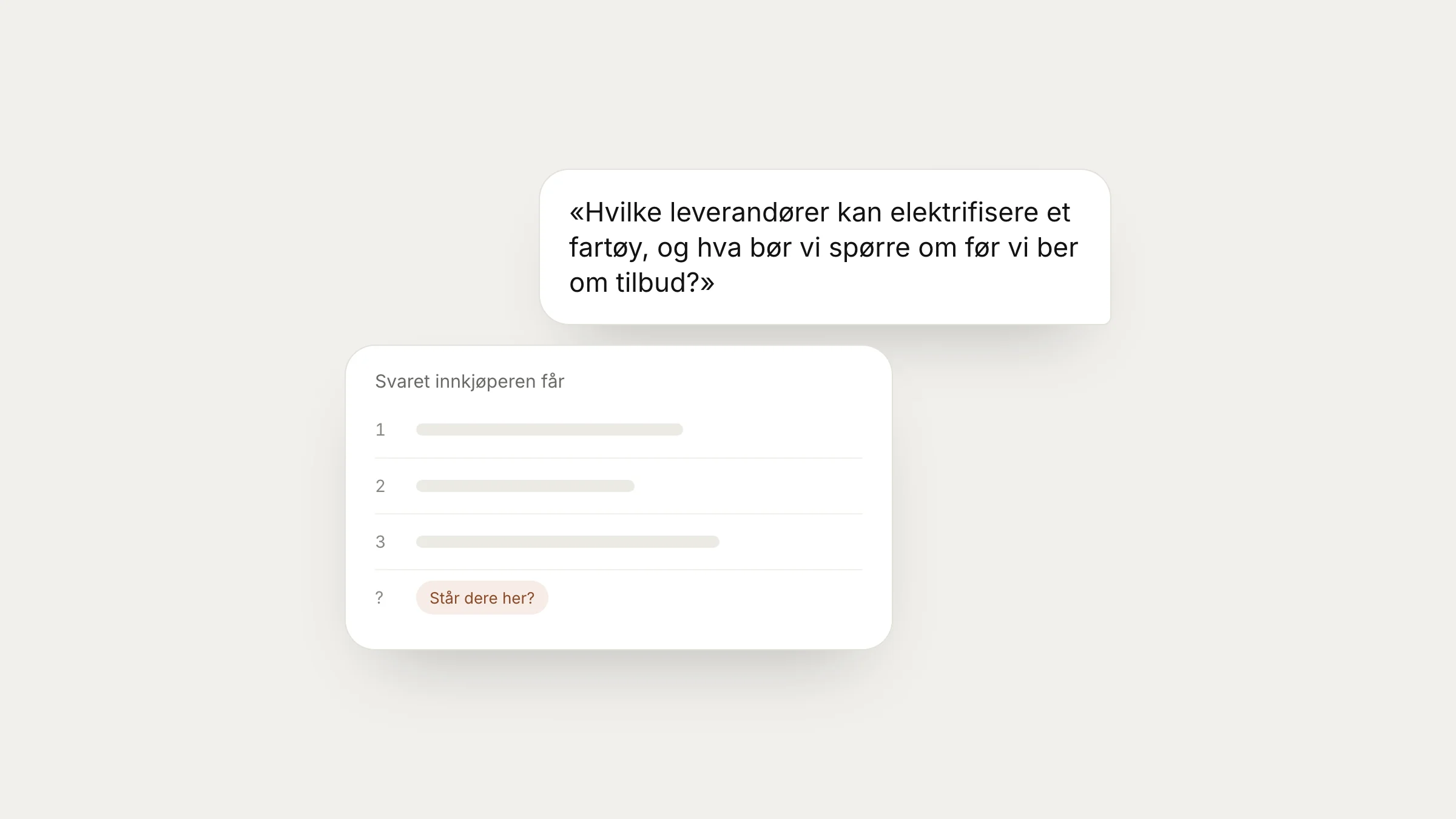
B2B companies with deep expertise should be chosen for what they can do, even when the buyer asks AI first. Here are the surveys, the numbers and where K—lab itself stands.
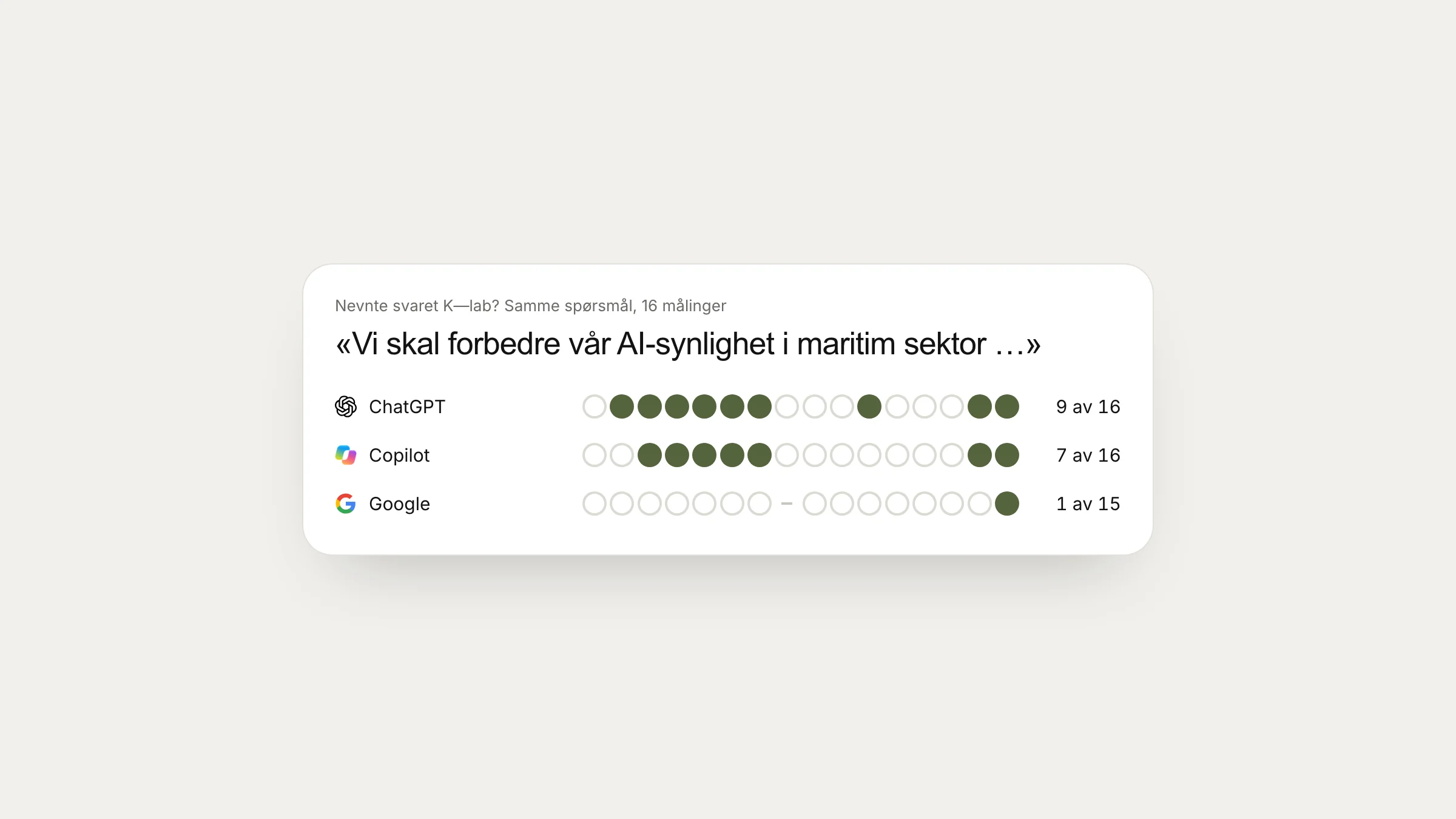
We asked ChatGPT and Copilot buyer questions every other day for a month. See how much the answers change, and why a single answer is only a snapshot.
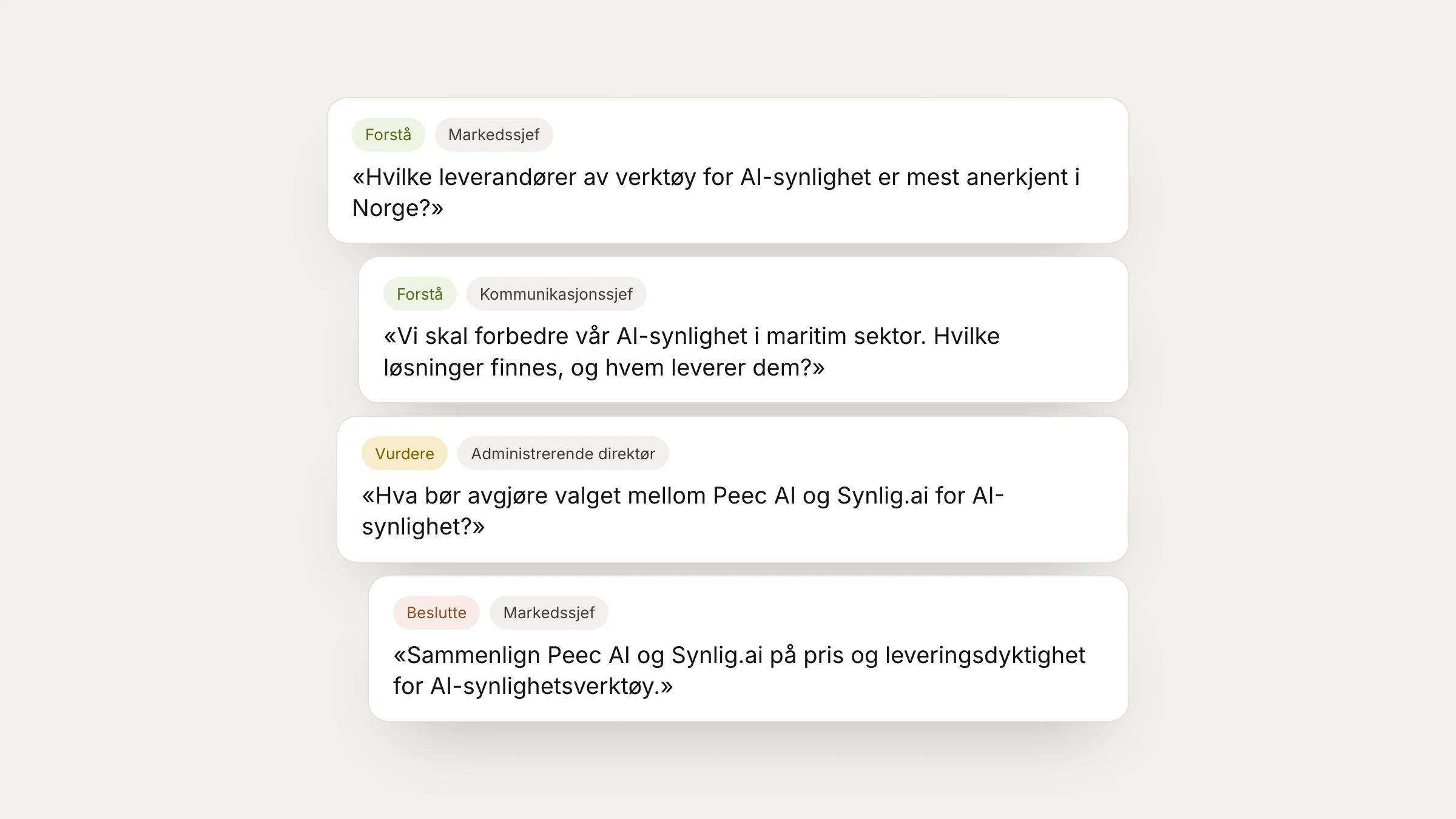
K—lab asks buyer questions written from buying situations in industry and the maritime sector. Here is how they are chosen, and how to build your own list.
Spend less time gathering and explaining results. Spend more time on the actions that actually deserve attention.