ChatGPT gives different answers to the same question because a language model writes the answer word by word with an element of randomness, and because answers with web search can draw on different pages each time. In our measurement of neutral buyer questions, every other day from October 19 to November 18, 2026, the list of brands mentioned changed in about 15% of back-to-back pairs of measurements in ChatGPT and about 18% in Copilot. When at least one of the answers mentioned a brand, the figure was over 40% in ChatGPT and about 45% in Copilot.
On Monday morning you ask ChatGPT who supplies what your company sells. You're on the list, in second place. You take a screenshot and send it to management. On Thursday a colleague asks the same question, and the list is different. You're gone.
Who got it wrong? Neither of you. This is how the services work, and it's why a single answer is never a measurement. Below we show how much our answers actually vary, with numerator and denominator, and what that means for how you read your own numbers.
Because the answer isn't looked up, it's written. The model picks the next word based on probabilities, so two runs of the same question can take different paths. OpenAI says so plainly in its prompt engineering guide: “Because the content generated from a model is non-deterministic,” getting the answer you want is a mix of art and science.
Microsoft is just as clear in its documentation on reproducible output: if you ask the same question several times, you are “likely to get a different response.” Their examples also show what this looks like. Three answers to the same question start almost identically, and the longer the answer gets, the more they diverge. Even with a fixed “seed,” Microsoft doesn't guarantee the same answer every time: “Determinism isn't guaranteed.”
Both pages describe the models as developers use them, not the chat you open yourself. The principle still applies in general, and the numbers below are our own.
Then there are the sources. Answers with web search draw on pages the model finds in the moment, and the service can split the question into several sub-searches, as we explain in What is query fan-out?. We haven't measured how much of the variation comes from the model itself and how much from the sources. We don't know.
We asked ChatGPT and Copilot the same neutral questions (in Norwegian) every other day from October 19 to November 18, 2026. Neutral means the question doesn't mention K—lab. That produced thousands of answers from each of them. Google AI Overview is not part of this analysis.
Then we compared two back-to-back measurements of the same question on the same platform. For each pair we looked at the list of tracked brands in the answers, meaning K—lab and the competitors we follow. Brands outside that list aren't counted.
The answers we collect aren't personalized. They have no logged-in history, no memory and no location, which makes them comparable over time. But an individual user may get something different from what we get, and the variation a logged-in user sees may be larger or smaller than ours.
In about 15% of pairs in ChatGPT and about 18% in Copilot, the list of brands mentioned was not the same from one measurement to the next.
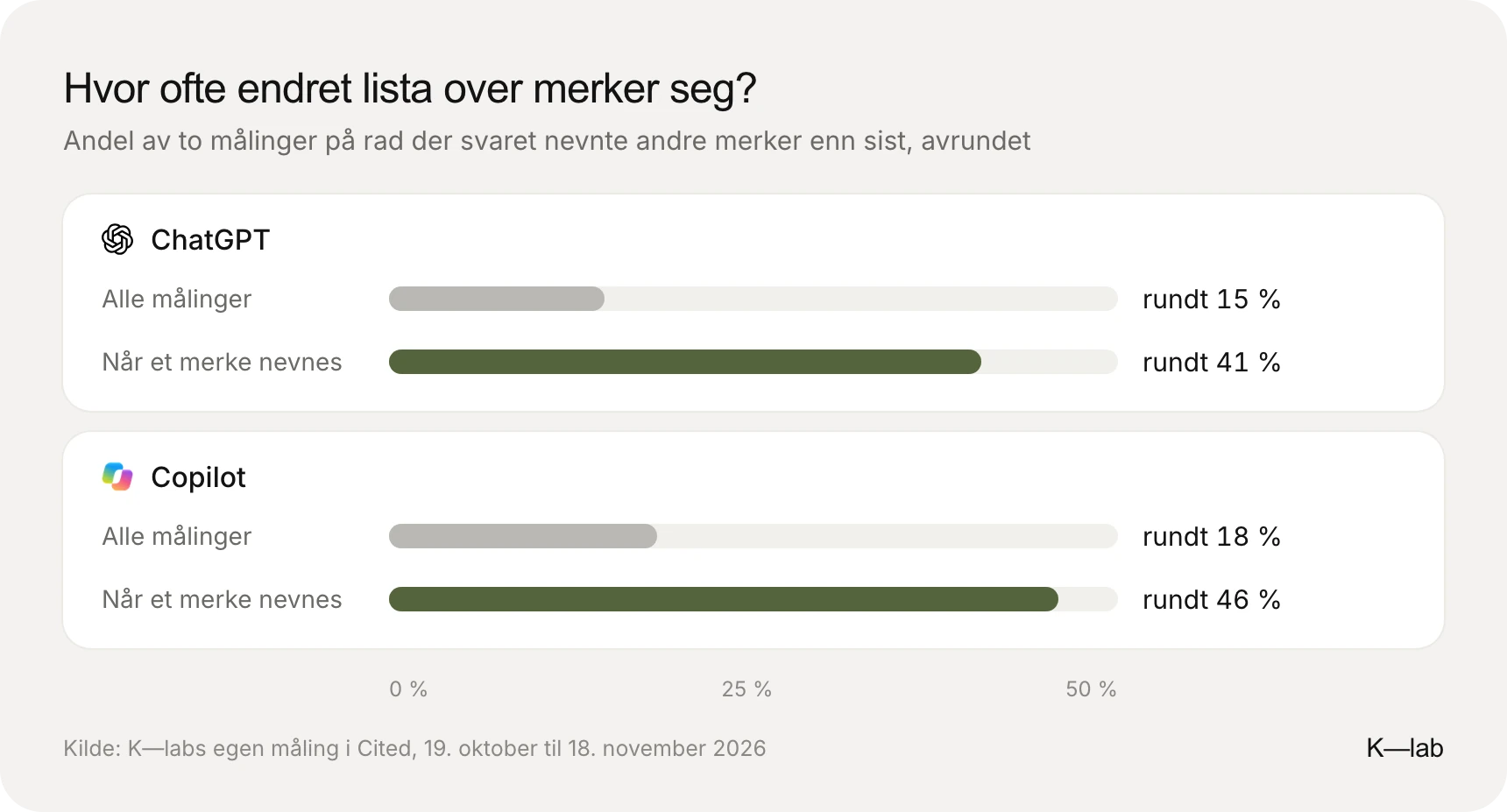
The figure is lower than you might expect, and the reason is simple. Only about one in three answers mentions a tracked brand, in both ChatGPT and Copilot. In most pairs, about 60%, neither answer mentioned any brands, and then the list can't change. That holds for both services.
If we look only at pairs where at least one answer mentioned a brand, the list changed in over 40% of pairs in ChatGPT and about 45% in Copilot. Nearly every other time.
All of them. They just count different things. In our guide to measuring AI visibility, we write that the list changed in under 10% of the compared pairs (November 4 to 18, 2026). That sample has different dates and more platforms, and it includes pairs without brands. The numbers here cover ChatGPT and Copilot separately, over the whole measurement period.
A percentage for “change” means nothing until you know what's in the denominator.
Mostly, yes. The answers have a stable core and an edge that fluctuates.
When both answers in a pair mentioned brands, the overlap averaged about 87%. We calculate it as shared brands divided by all brands in the two answers. The same brand was at the top in both measurements in over 80% of pairs, in both ChatGPT and Copilot. That means first place changed hands in nearly one in five pairs.
We see the edge when we follow each combination of brand and question through the whole month. Of the combinations that appeared at least once, about 17% came up only once in ChatGPT and about 25% in Copilot. Only about 27% in ChatGPT and about 22% in Copilot were present in at least three quarters of the measurements.
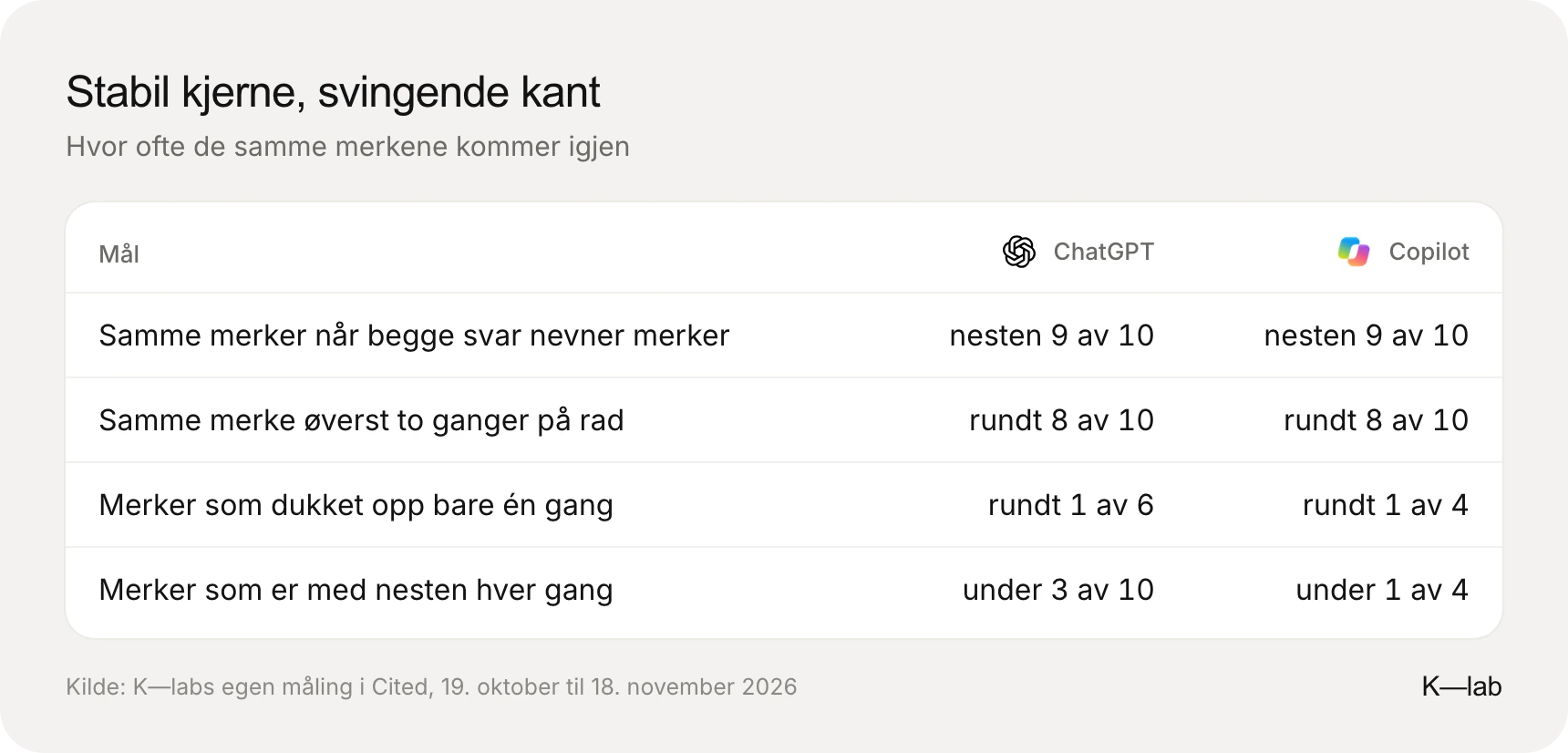
Fewer than three in ten combinations are fixed. The rest come and go.
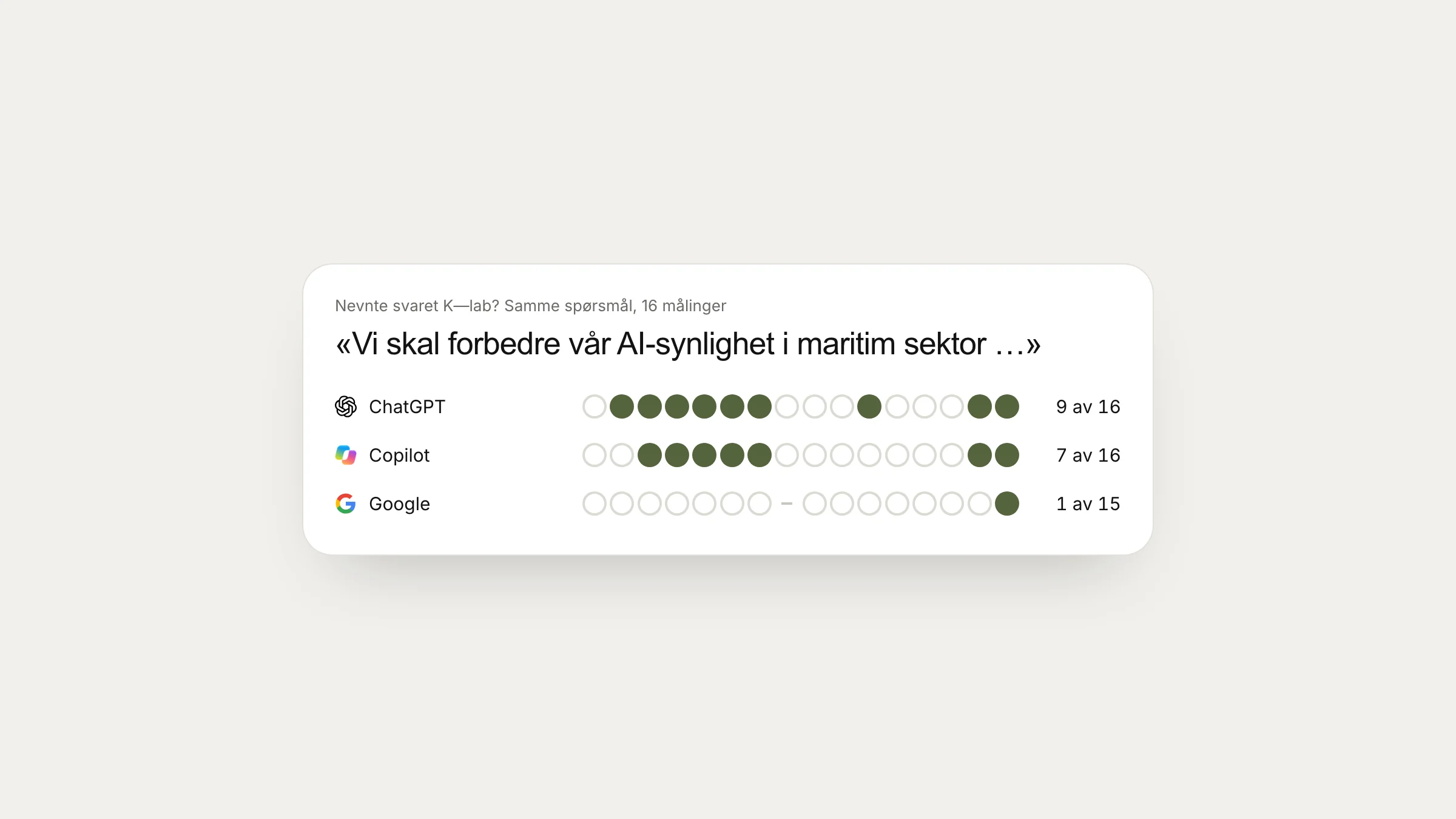
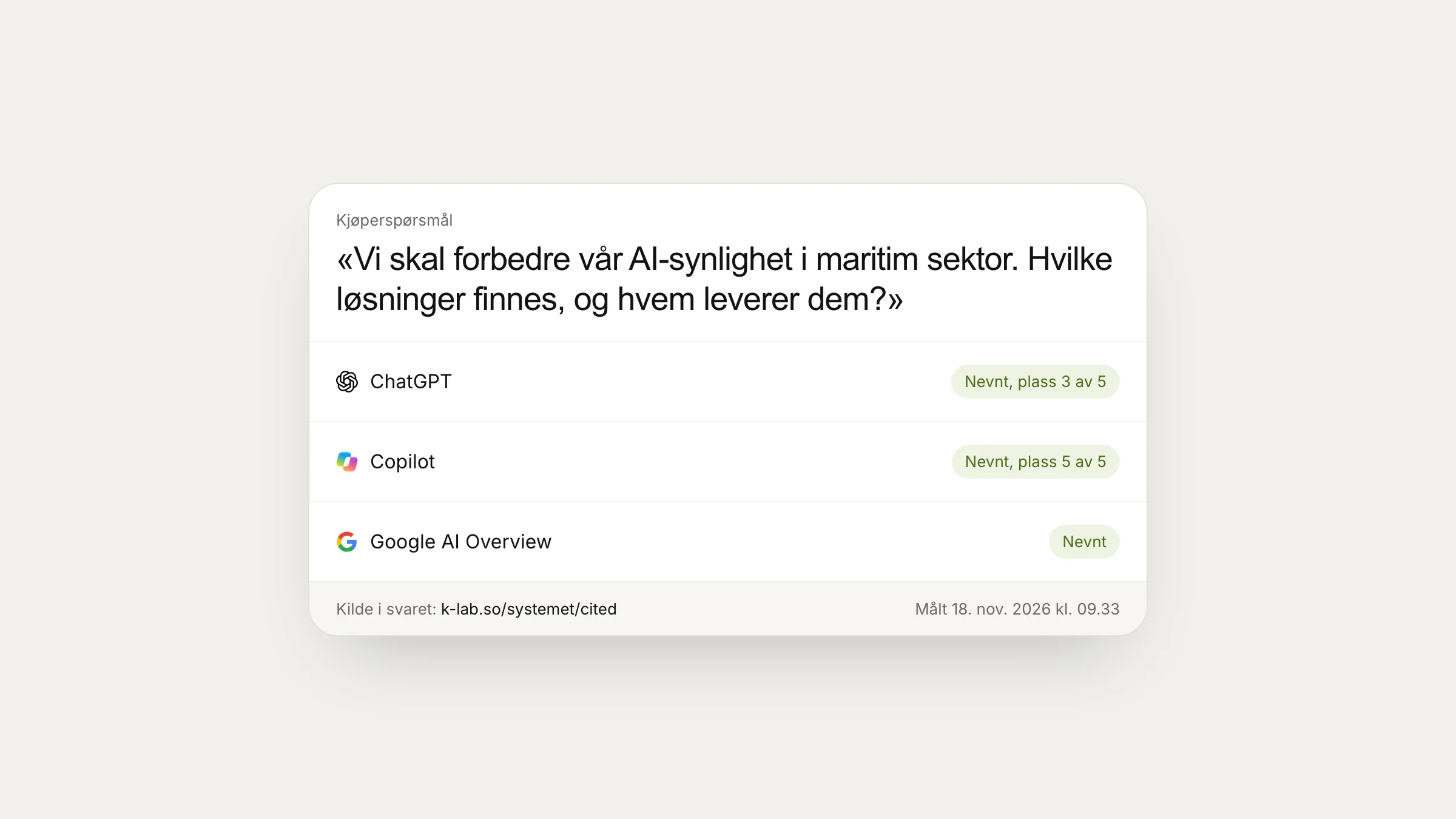
The numbers above are averages. Take one question, the way a buyer in the maritime industry might write it: “We want to improve our AI visibility in the maritime sector. What solutions are out there, and who provides them?” (asked in Norwegian). We asked it to all three services on November 18, 2026 at 09:33 (Norwegian time).
All three services mentioned the same five vendors: Sorank, Synlig.ai, CitationLab, Sitera and K—lab. The order differed. Sorank came first in all three, and K—lab came third in ChatGPT and fifth in Copilot.
Over a month, the picture looks different. From October 19 to November 18, ChatGPT mentioned K—lab on this question in just over half of the measurements, Copilot in under half and Google AI Overview only once (on one occasion, Google showed no AI Overview at all). At the end of October, ChatGPT and Copilot included us in every measurement. From November 2 to 14 we appeared only once, in ChatGPT on November 8. On November 16 we were back, and on November 18 all three mentioned us at the same time for the first time.
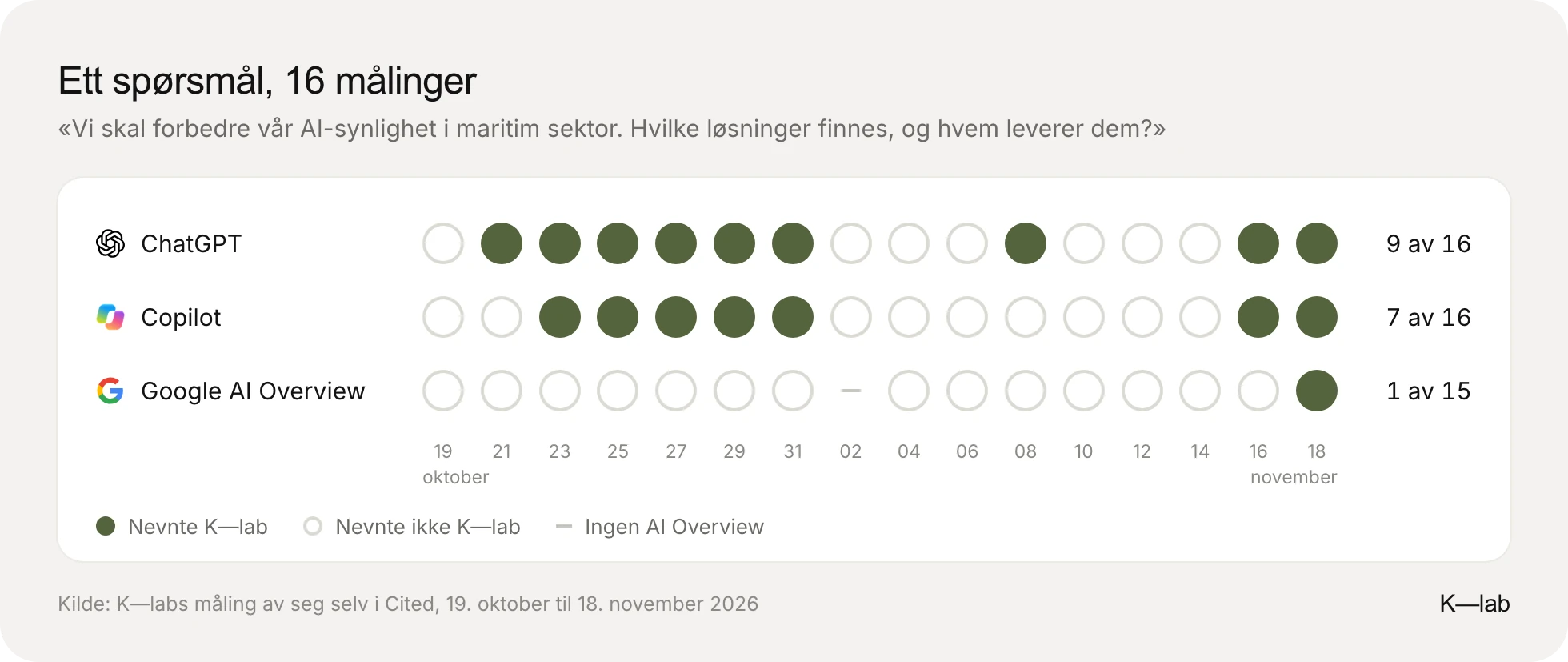
We can't point to a single cause for the gap in November. The point is a different one: if we had measured only on November 10, we would have thought we were gone. If we had measured only on November 18, we would have thought we were everywhere. Both are true for one morning. We show what you can do with a finding like this in our article on the data behind Cited.
One answer is a snapshot. Monday's screenshot is true, but it doesn't tell you what happens on Thursday.
Four things follow from our numbers:
You'll find a step-by-step setup in the guide to measuring AI visibility. We explain which questions are worth measuring in the article on the questions we measure.
Several things, and they belong here.
The numbers apply to K—lab's own questions about AI visibility and the competitors we follow. Other industries may vary more or less. We have a limited set of questions, two platforms and one month of measurements, and that isn't enough to say what the variation looks like over a year.
We also haven't broken the changes down into who came in, who dropped out and who just swapped places, and we don't know how much is due to the model and how much to the sources. Our answers aren't personalized, so a logged-in user may see something different.
But the direction is clear enough that we build K—lab on it: we measure the same question again and again, and we show you the answers behind the number. If you want to see how often ChatGPT, Copilot and Google mention you, you can get a free AI visibility check. If you want to follow the trend over time, that is what Cited is built for: the same questions, many measurements, and findings that become tasks in Work.
Because the model writes the answer based on probabilities, not by looking it up. OpenAI calls the content “non-deterministic,” and Microsoft writes that you are likely to get a different answer each time you ask the same question. Answers with web search can also draw on different pages.
In our measurement, the list of brands mentioned changed in about 15% of pairs of back-to-back measurements. When at least one of the answers mentioned a brand, the figure was over 40% (October 19 to November 18, 2026).
Not reliably. Microsoft writes that determinism isn't guaranteed, even when developers fix the settings. As a chat user, you don't have those settings.
More than once, and ideally enough that you can say “mentioned in X of N.” We have measured every other day for a month. How many times you need depends on how stable your position is, and we don't know that in advance.
No, not necessarily. The answers we collect aren't personalized: no logged-in history, no memory and no location. That makes them comparable over time, but an individual user may get something different.
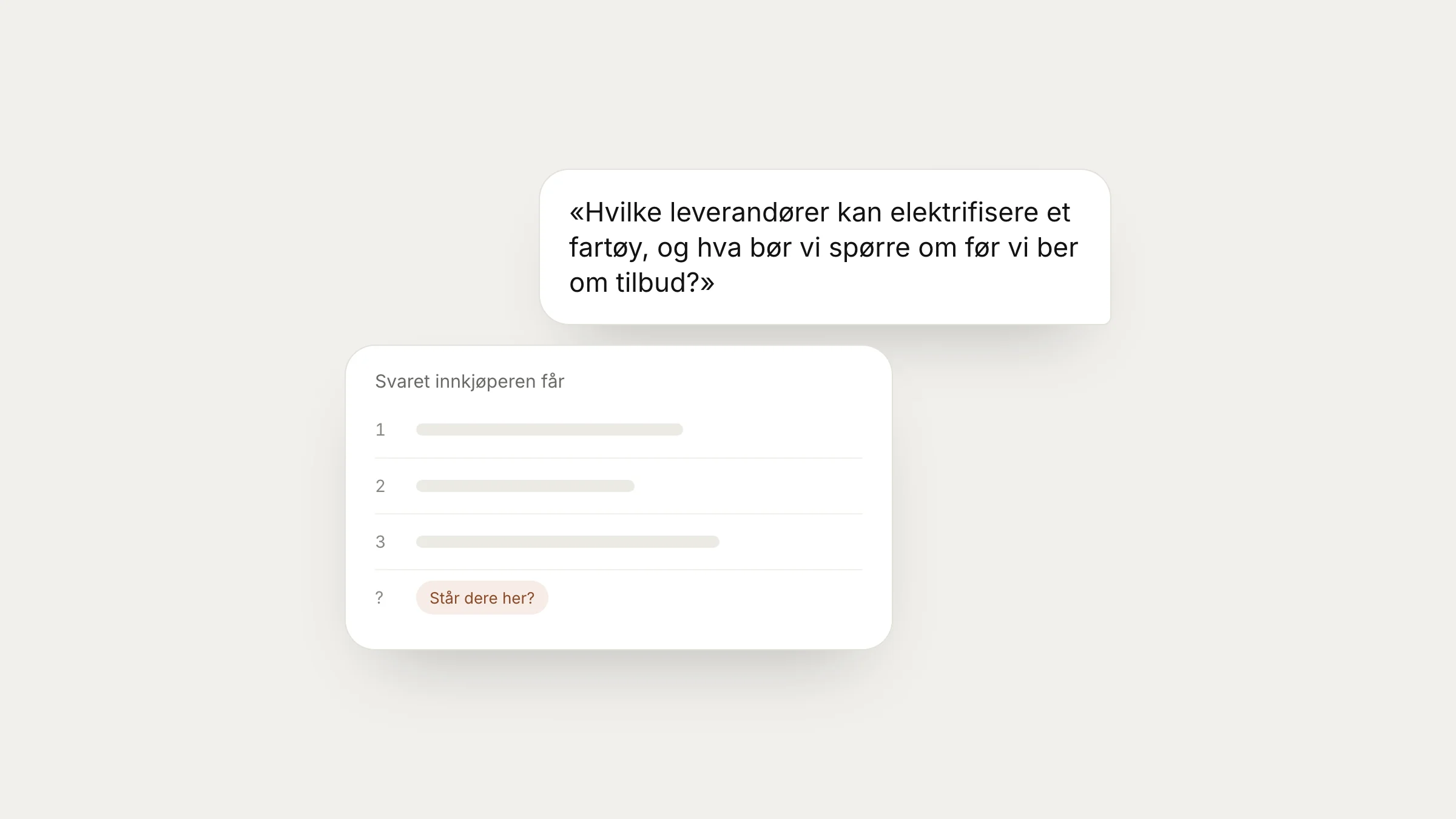
B2B companies with deep expertise should be chosen for what they can do, even when the buyer asks AI first. Here are the surveys, the numbers and where K—lab itself stands.
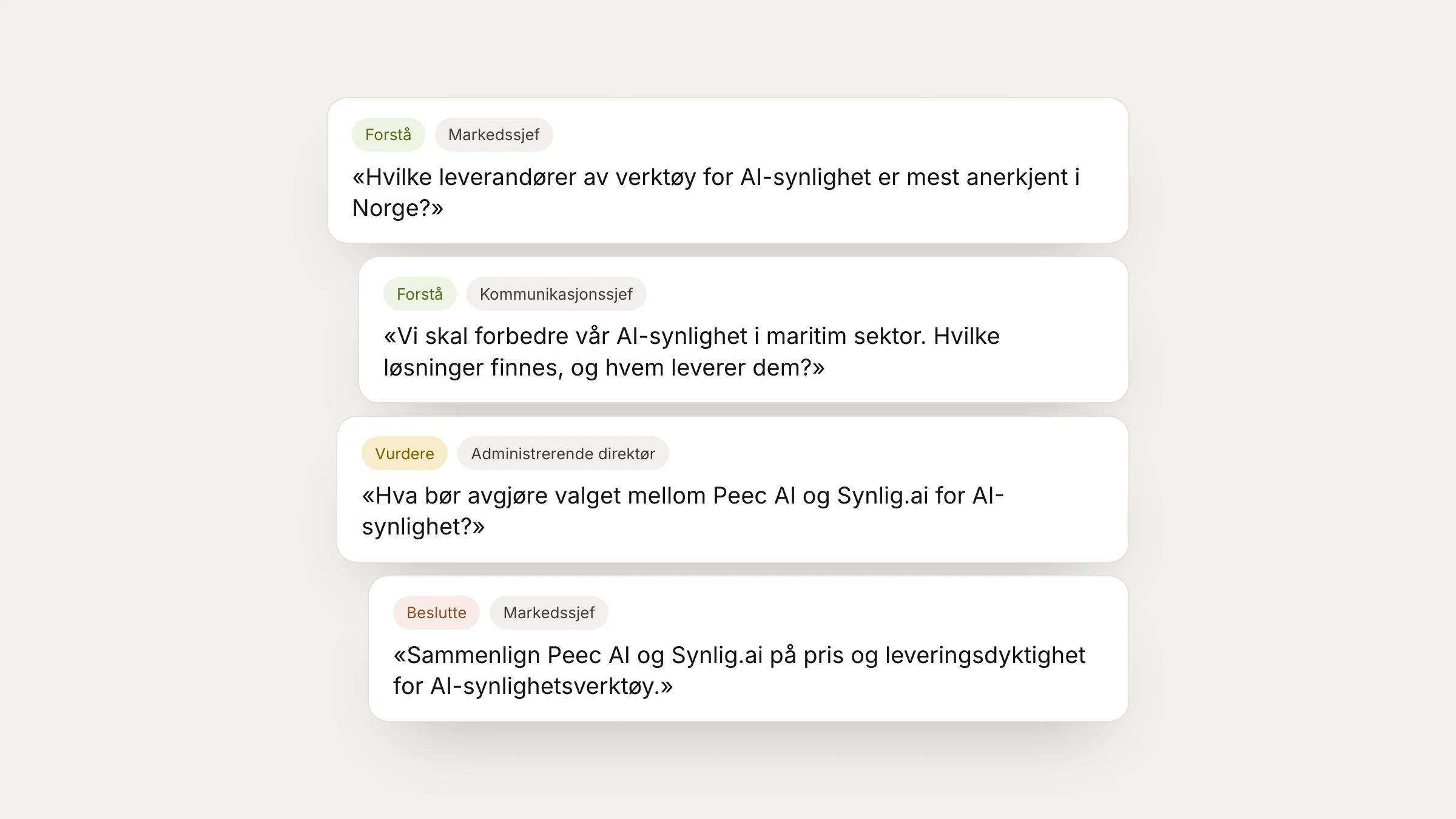
K—lab asks buyer questions written from buying situations in industry and the maritime sector. Here is how they are chosen, and how to build your own list.
Over 100,000 AI answers and over 600,000 source citations. What sets the data in Cited apart, how we count and what the measurement does not capture.
Spend less time gathering and explaining results. Spend more time on the actions that actually deserve attention.